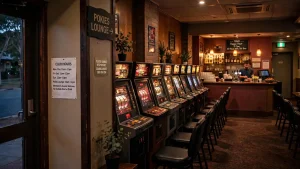
The guide distinguishes poker and tournament claims from older listings, and covers accommodation, dining, parking and other venue details to verify.
A poker room is a specific claim, not a synonym for a casino floor. It implies a place where live poker is dealt, with tables, staff and rules for joining a game. A tournament is a separate claim: it needs a scheduled event, a format and a way to register. I would not treat either as confirmed in Hobart without current information from the venue.
That distinction matters because a search for poker at a Hobart casino can return old event listings, general casino descriptions or pages that use “poker” loosely. None of those, by itself, establishes that live poker is running now. A past tournament notice does not prove that the event has returned, and a reference to poker facilities does not establish that a table is open on a particular day.
For a room to be useful to a player, the practical details have to line up: whether games are dealt live, which formats are offered, when tables operate, and how a seat is obtained. If only occasional events are held, that is different from a regular cash-game schedule. If the venue lists poker but does not specify a live table or event, the wording may describe a general category rather than a service available to visitors.
For Hobart players considering online casinos in 2026, this list offers a concise starting point for checking operator details. Review the available payment and licensing information alongside the terms that matter to you.
7Bit Casino
7Bit Casino is operated by Dama N.V. and lists a Curaçao licence.
MrPacho
MrPacho lists crypto payouts of 30–120 minutes and fiat payouts of 24–72 hours. Its minimum deposit is A$30.
SkyCrown
SkyCrown lists a Tobique Gaming Commission licence. Its stated payout times are around 10–15 minutes for crypto and 1–5 days for fiat; the minimum deposit is A$30.
Wild Tokyo
Wild Tokyo lists a Curaçao licence, with a minimum deposit of A$10. Stated payout times are 30–60 minutes for crypto and 1–5 days for fiat.
Uptown Pokies
Uptown Pokies lists a Curaçao licence and has been operating since 2017. Its minimum deposit is A$20.
Thor Casino
Thor Casino lists a Curaçao licence from Antillephone N.V., with Versus Odds B.V. named as the operator. Its minimum deposit is EUR 20.
Roby Casino
Roby Casino lists a Curaçao eGaming licence, with Roby Games Ltd named in its licensing details.
Ricky Casino
Ricky Casino lists crypto payouts in under an hour and PayID payouts in 1–3 business days. Its minimum deposit is A$20, or A$30 to qualify for the bonus.
GoldenCrown
GoldenCrown lists Curaçao Gaming Control Board licence OGL/2023/176/0095, with Hollycorn N.V. named in its licensing details.
LevelUp Casino
LevelUp Casino lists Curaçao eGaming licence OGL/2023/174/0082, with Dama N.V. as operator. Its minimum deposit is A$15.
I pay attention to the tense of venue information. “Hosts” or “offers” can sound current even when a page has not been updated. A dated event calendar, current booking channel or direct confirmation is more informative than an undated promotional paragraph. If the details cannot be confirmed, the honest answer is that availability is uncertain—not that a room or game exists because the name appears in a listing.
A credible tournament notice should explain the event’s date and start time, the game being played, registration arrangements, and any conditions for joining. Those details allow a visitor to distinguish a scheduled tournament from a general statement that the venue has poker. If an event page gives no current date or registration instructions, it is not a reliable basis for planning a trip.
Tournament language can also blur the line between a regular series and a one-off event. “Poker tournaments” in a headline may refer to historic events, a past season or a listing copied across multiple sites. I would look for a current calendar and confirm that the event is still proceeding before treating it as available. A listing is not a seat. Small distinction, real consequence.
For live cash games, the equivalent checks are whether a table is actually running, what format is being dealt and how players join. A venue may have a poker table without running games every day; it may also host events without maintaining regular cash games. Those are different operating arrangements, and a broad “poker” label does not tell which one applies.
A venue being open does not establish that poker is available. Casino-wide operating status and poker-room hours are separate pieces of information. A room can have different hours, a game may depend on staffing or participation, and an event may be scheduled only on selected dates. These are general operational distinctions, not confirmation of Hobart’s current arrangements.
The same caution applies to wording such as “open today” or “open now”. Without a current operating notice for the relevant poker service, a general opening-hours result cannot answer whether a live game is running. Where the distinction matters, confirm the poker schedule specifically rather than relying on the venue’s broad status.
I would also separate “rooms” as a search term from evidence of a dedicated poker room. The word can appear in a venue description without explaining whether live poker is dealt there, whether tables are open to the public, or whether events are being held. Those details need to be stated plainly.
For anyone comparing claims, the useful standard is simple: current, specific, and attributable to the venue. A confirmed event listing can support a claim about that event; it cannot automatically support claims about daily games or a permanent poker room. Until those particulars are clear, Hobart poker-room and tournament availability should be treated as unconfirmed. No assumed tables.
Choosing accommodation for a casino visit is not simply a matter of finding the closest bed. The useful comparison is between the whole stay and the reason for travelling: location, transport, cancellation conditions and the cost of plans changing. I have seen “nearby” do a lot of work in travel copy. It can mean a short walk, a ride, or a location that only looks close on a small map.
For Hobart, the first task is to establish the venue’s current location from an authoritative listing before comparing places to stay. A property advertised as convenient for a casino may be convenient only for a particular route or mode of transport. Map distance is not the same as a practical journey, especially when arrival and departure times, luggage or mobility needs are part of the plan. Check the route itself, not just the pin.
A casino accommodation deal can sound more valuable than it is when the headline is separated from its conditions. The offer may depend on dates, room availability, a minimum stay, a particular booking channel or a qualifying activity. Those conditions matter more than the word “deal”. I would compare the final payable price and cancellation terms against an ordinary booking for the same dates, rather than treating a promotional label as a saving.
The same discipline applies to casino promotions. A package, voucher or advertised benefit should be confirmed with the business responsible for providing it, including whether it is still available and whether it applies to the intended stay. A listing on a third-party travel site is not, by itself, confirmation that a casino-related offer will be honoured. If the terms are unclear, the value is unclear too.
There is also a difference between accommodation near a casino and accommodation sold as part of a casino visit. The first is an independent travel choice; the second may bundle conditions or benefits. Neither description establishes what is currently available in Hobart. Names, rates and inclusions should be checked against current provider information before money is committed.
The cheapest room can become a poor choice if a late arrival, an early departure or a change of plans makes the location inconvenient. Flexible cancellation may cost more at first, but it has a distinct value when travel arrangements are uncertain. The opposite can also be true: paying extra for flexibility that is unlikely to be used may not make sense. The terms decide.
Parking is another detail that can affect the accommodation comparison, but it should be checked with the property rather than assumed from a map or booking summary. Confirm whether parking is offered, whether it is included, and whether any restrictions apply. Those are separate questions from whether parking is available at the casino itself.
I would keep the booking decision separate from assumptions about gaming machines, poker machines or venue trading hours. A search result or old review is not reliable confirmation of present-day services or operating arrangements. Verify the venue details through current official information, then make the accommodation choice on its own merits. This prevents a room booking from depending on a facility, promotion or schedule that may not match the plan.
In practice, the sound comparison is plain: total cost, journey, cancellation terms and confirmed inclusions. Promotional language comes second. Conditions first.
A “casino hotel” can describe more than one arrangement. The hotel may be operated by the casino, share a site with it, or simply be marketed as a convenient place to stay nearby. Those distinctions affect what a booking actually includes. I would treat the label as a starting point, not proof that a Hobart casino has rooms of its own.
For anyone considering a Hobart casino hotel, the first check is the identity of the accommodation provider. The name on a booking page, the business responsible for the room and the casino operator may not be the same. A close association in promotional wording does not establish common ownership or an on-site connection. The address and property description should make clear whether the hotel is inside the casino complex, next door or elsewhere in Hobart.
Room descriptions can sound more definite than the booking terms. “Casino view”, “casino access” and “stay and play” are not interchangeable. A view does not establish direct access; a package label does not, by itself, explain what is included. I look for the specific room category, what the rate covers and any conditions attached to extras. If the page leaves those points vague, the headline is doing more work than the offer.
The same applies to facilities. A photograph or a broad description is not confirmation that a particular room has a feature, that it is available on every rate, or that it will be available during the stay. Room features, access arrangements and service conditions need to be stated for the chosen booking, rather than inferred from a general property description.
“Luxury” is a sales word. What matters is the room specification and the terms attached to it. A polished image cannot settle whether a room category has the layout, facilities or access described elsewhere on the site. I would keep the booking confirmation and the room description together, so any mismatch is visible before arrival.
The phrase “hotel near Hobart casino” can refer to a separate accommodation business, not casino hotel rooms. That matters when a package suggests convenience or a connection to the venue: the wording should identify what is physically on site and what requires a separate arrangement. No assumption about a hotel’s relationship to a casino should be drawn from proximity alone.
Likewise, casino opening hours or advertised shows are not room attributes. If a booking is sold around access to the casino or an event, those details should be confirmed independently and tied to the dates in question. A room reservation does not, on its own, establish that a venue is open, that a show is scheduled or that entry is included.
Before paying, the useful record is simple: the property’s exact name and address, the room category, the inclusions, the cancellation conditions and the party responsible for the booking. If the casino-hotel link is central to the decision, it should be explicit in the confirmation rather than implied by a photograph or slogan.
That is the distinction I would keep in view when assessing casino hotels in Hobart: a nearby room, a room within a casino complex and a hotel operated by a casino are different propositions. Until the property and terms are clear, the label tells very little.
Parking, bingo and dining are practical parts of a casino visit, but a search for a Hobart venue does not establish that any particular service is available. I treat each as a separate claim to confirm rather than assume it comes with the venue. “Free parking” is especially easy to misread: the phrase might refer to a nearby public option, a condition attached to a visit, or a facility that is not available at all. Valet parking is a distinct service, not another name for ordinary parking.
Before relying on a parking arrangement, the useful details are its location, access conditions, operating times and any cost or eligibility rules. Those conditions can change the practical value of a visit. A listing that simply says “parking” leaves too much unsaid; it does not establish whether spaces are on site, whether they are free, or whether valet service is offered.
Bingo should be checked independently. Its presence at another club or gaming venue would not demonstrate that it is offered at a Hobart casino, and a reference to bingo does not say whether sessions are current or how they operate. The same discipline applies to dining: the word covers a range of possible services, but it does not confirm a particular outlet, menu or service time. Those are operational details, not reliable assumptions to carry over from another venue.
The online-casino question is different because it turns on Australian law, not on the facilities of a physical venue. Under the Interactive Gambling Act, an operator based in Australia cannot lawfully provide real-money online casino games to people in Australia. That restriction covers casino-style games such as pokies, blackjack and roulette. A physical casino and an online service are not interchangeable categories: the existence of a venue does not make an online casino service lawful.
Offshore platforms are not regulated under Australian law. The fact that an offshore site may describe itself as licensed elsewhere does not make it an Australian-regulated casino or give it local oversight. The legal distinction is important: Australian law prohibits operators from providing these services to people in Australia, while offshore sites sit outside the Australian regulatory framework. “Available online” is not the same as locally authorised.
I would not treat a site’s access page or game lobby as proof of legal status. Online casinos can use a player’s IP address to identify geographic location and restrict access by region; a game can be absent from the lobby or fail to load because of such a restriction. These are technical controls, not a substitute for Australian regulation. Nor does a venue’s name appearing beside an online result establish a connection between the two.
For a Hobart visit, the sensible distinction is straightforward: confirm parking, bingo and dining as separate venue-specific arrangements, and assess online casino claims under the law rather than by branding or search results. Marketing compresses those differences. The terms do not.
A venue name in a map app is not enough to establish that the pin, entrance or contact number is current. I treat contact details as operational information, not decoration: a wrong number can send a visitor to an unrelated business, while a misplaced map pin can direct them to a service entrance or nearby road. Before setting off, compare the venue name and address shown in the map listing with the details on an official venue channel. If they do not match, pause rather than assuming the map is right.
The same applies to telephone listings. Search results can preserve old numbers after a business changes hands or updates its contact arrangements. A listing labelled “casino contact number” does not confirm that the number reaches the venue, nor that it handles general enquiries. Where an official channel provides a number, check that it is presented as a current contact point and note whether the enquiry relates to access, an event or a gaming service. Those are not always handled by the same team. No guesswork.
A map pin also answers only part of the access question. It may identify a building without showing which entrance is intended for visitors, and a route can depend on the approach direction. The car-park label in a map app should not be treated as proof that parking is available to casino visitors, or that its entrance is where the pin suggests. Confirming access arrangements through the venue’s own information is more reliable than relying on a third-party map label. This is about finding the correct arrival point, not assuming a particular parking facility.
A bar search can return a venue listing, photographs or old mentions without establishing that a bar currently operates there. Nor does the word “bar” settle what is served, when it is open or whether access is limited during private functions. I would look for a current venue notice before building an evening around that assumption. A polished photograph is not an opening-hours notice.
Baccarat and craps require the same distinction between a general casino reference and a confirmed table offering. The games are not interchangeable, and a search result mentioning one does not confirm that either is available at a particular venue. Table games can also be subject to operating schedules and access conditions. The useful confirmation is specific: the venue’s current information should identify the game and whether it is running on the intended visit date. Without that, neither a table nor a session should be treated as assured.
Concert listings can age quickly. An old event page may remain visible after tickets have gone, a date has passed or arrangements have changed. A current listing should state the performer, date and venue, with a booking route that matches the venue or event organiser. Check the organiser’s update if the venue page and ticket information disagree. “Live entertainment” is broad wording; it does not establish that a concert is scheduled.
For any visit, the practical sequence is simple: confirm the venue identity, check its current contact channel, verify the precise entrance or event location, then confirm the particular service being sought. Those small checks separate a real arrangement from a search listing that merely looks complete.
Breakfast searches often blur three separate things: a meal offered by a venue, a buffet advertised for a particular service period, and breakfast included in a stay. Those are different promises. A page describing a “casino resort” does not, by itself, confirm that breakfast is served at the casino, that a buffet operates, or that any meal is part of a room booking. I keep those claims separate; promotional wording can make them sound like one package when the conditions may differ.
For a Hobart visit, breakfast or buffet details need confirmation against a current venue listing or booking information. Useful particulars are the service dates and times, whether the meal is open to non-guests, what the quoted price includes, and whether a reservation is required. A buffet may be listed for a particular service rather than as an everyday option. A photograph or an old review cannot settle present availability. Small print matters.
“Resort” is another word that can carry more weight than it earns. It may describe a broad leisure proposition, but the label alone establishes neither a Hobart property nor its facilities. I would look for the named operator, a current description of what is actually on site, and terms that distinguish included services from paid extras. A polished package name is not a facility list. That distinction is easy to miss.
A casino rewards programme, if one is offered, should be understood through its written terms rather than its headline. The practical questions are how membership is earned, what activity qualifies, whether benefits expire, and whether restrictions apply to particular offers. A rewards label does not establish that a programme is currently operating in Hobart, or that a particular benefit is available. The conditions do the real work.
Employment searches need the same discipline. A result mentioning casino jobs in Hobart is not proof of a current vacancy or even of the employing entity. Before relying on an advert, I check that it names the employer, describes the role and its location, and provides a genuine application route. An old listing can remain visible after recruitment has closed. No vacancy should be inferred from a general careers page or a third-party summary.
Casino work can involve different functions, but a generic description cannot tell whether a local employer is hiring for any of them. The advert should specify duties, hours, required experience and employment conditions. It should also make clear who employs the staff; a venue name and a legal employer are not always the same thing. Read the actual posting.
I would treat breakfast, buffet, rewards and recruitment as four independent claims, not as evidence for one another. A breakfast listing does not prove a resort package; a rewards page does not establish a job opening; and an employment advert does not verify food service. For the Hobart-specific details, current published terms are the useful test. Until those details are confirmed, “available” is too strong a word. That is the safer reading.
A search for whether a Hobart casino is open can produce an answer that is technically accurate but no longer useful: a directory may retain ordinary hours after a temporary closure, a schedule change or a change in venue operations. I treat opening times as date-specific, not as a permanent feature. Before making plans, the useful check is a current notice from the operator or venue, including any stated exceptions for public holidays or private events. If no current notice can be found, an old listing is not confirmation.
“Open” can also mean different things. A venue may be operating while a particular area, service or scheduled activity is unavailable. Published hours should therefore be read for what they actually cover, rather than assumed to apply to every part of the premises. Small distinction. Practical consequence.
Entertainment listings need the same care. A past performance or event page can remain visible after the date has passed, and a general events calendar does not establish what is happening on a particular night. I would look for a dated listing that identifies the event and its status, then check for a later cancellation or change notice. Without that, an advertised entertainment programme is a lead, not a confirmed plan.
Development claims require an even firmer distinction between proposal and delivery. A concept, planning announcement or construction report does not by itself show that a project has been approved, funded, completed or opened to the public. For a Hobart casino development, those are separate stages and should not be compressed into a claim that the venue is expanding or reopening. The wording of the announcement matters. “Planned” is not “open.”
Reopening language can be especially ambiguous. It may refer to a temporary closure, a specific facility or a broader change in operations. A headline alone rarely settles which meaning applies. The date, the named venue and the scope of the notice are what make the update useful.
Employment information also dates quickly. A vacancy shown on a third-party listing may have closed, while a broad careers page does not establish that a Hobart role is available. A current listing should identify the employer, location, position and application status. If those details are missing, it is not a reliable basis for treating a job as open.
For an overall review, I separate what can be confirmed now from what is merely described or anticipated: current operating status, dated entertainment notices, documented development stages and live vacancies. That approach is less exciting than a confident claim about a reopening or a packed events calendar. It is also more useful.
A venue name in a map result is not enough to establish that it is the casino being sought. Addresses can be attached to outdated listings, event pages or businesses with similar names. I would match the street address against the operator’s own current venue information, then check that the map pin and the venue name agree. If those details conflict, the discrepancy matters: it can send visitors to the wrong entrance or an unrelated business.
The same caution applies to dress expectations. “Smart casual” sounds clear in promotional copy, but it can leave room for interpretation at the door. A policy may distinguish between gaming areas, bars and special events, or set rules about footwear and clothing. Those conditions are venue-specific, not something that can safely be inferred from another casino’s policy. The useful detail is the current rule published by the venue or confirmed by its staff. Not an assumption.
A spa search result also needs careful reading. A day spa may be inside a casino, in a nearby hotel, or simply use the casino’s location in its listing. “Spa” can refer to a treatment business rather than a broader wellness facility, and the name alone does not establish access arrangements, services or opening status. I would look for an operator-controlled page that identifies the facility and its location before treating it as an on-site amenity.
Bars and careers are related checks, but they require separate evidence. A bar listing should identify the venue and show whether it is part of the casino property; a job advertisement should identify the employing business and direct applicants to an official recruitment channel. Old listings can remain visible after details change. Promotional wording is not confirmation. The operating entity is.
The word “games” also needs context. Physical casino games and online casino services are not interchangeable. Under Australia’s Interactive Gambling Act 2001, operators cannot provide real-money online casino games, including slots, poker and table games, to people in Australia. A page describing online pokies or casino play should not be read as evidence of a lawful local service. That is a different question from what a physical venue offers.
I use a simple standard for on-site claims: confirm the exact venue, confirm the detail with a current operator-controlled source, and check that the wording describes the property itself rather than a nearby business or third-party listing. If the detail cannot be tied to the venue, it should not be treated as settled.
A restaurant attached to a casino is a specific claim, not a safe assumption based on the venue’s size or reputation. For Hobart, restaurant names, menus, service times and current availability need confirmation before they are presented as features of the casino. A search result or an old directory entry may describe a past arrangement; it does not establish what is operating now.
I have seen how easily a dining listing outlives the service it describes. A venue can change its name, alter its format or stop trading while copied descriptions remain online. The practical test is whether the casino’s own current information identifies the restaurant and states that it is open to guests. If that detail cannot be checked, the responsible wording is that the restaurant offering is unconfirmed—not a confident list assembled from stale references.
The distinction matters for anyone comparing restaurants at the Hobart casino with places elsewhere in the city. “At the casino” should mean an identified dining venue within the property, not a nearby business, a bar that serves food, or an outlet mentioned in an old travel page. Location, access and trading status all affect whether a listing is useful. A name without those basics can send diners to the wrong place or leave them planning around a service that is no longer available.
Menus require the same care. A broad label such as “restaurant” says nothing reliable about cuisine, dietary options, booking arrangements or whether service is limited to particular periods. Those details can change, so a published menu should be treated as current only when it is dated or maintained by the venue. If no current menu is available, describing dishes or making claims about choice would be guesswork.
I would also keep restaurant information separate from claims about breakfast, buffets, food courts and rooftop bars. They are different services, and evidence for one does not establish another. A photograph of a dining room, for instance, cannot confirm what is served or whether the room is still in use. Nor does the phrase “casino restaurant” prove that a meal is included with entry or accessible to every visitor.
For a Hobart casino restaurant listing to be dependable, it should identify the venue, show current operating information and link to a menu or booking channel maintained by the business. Until those details are confirmed, the most accurate account is limited: restaurant names, menus, opening times and availability remain matters to check directly. No invented certainty.
Food-court wording suggests a particular kind of service: several casual food options grouped in a shared area, rather than a single dining venue. That distinction matters when assessing claims about food at a Hobart casino. A page that mentions food does not, by itself, establish that a food court operates there, what it serves, or whether it is currently open.
I separate the claim from the evidence. A current venue listing or direct confirmation should identify the food service as a food court, rather than relying on a broad reference to casino food. Menus, trading hours and access conditions can change, so older promotional copy is not enough to establish what is available on the day. No assumption should be made that casual food service is included with entry or available during every visit.
A pool is a different proposition altogether. It is a leisure facility, not an extension of the casino’s food offer, and a mention of a pool needs its own confirmation. The word can refer to an on-site swimming facility, but a search result or generic description does not establish that one exists at a Hobart casino. Nor does it clarify whether access is public, restricted to guests, or subject to operating conditions.
From the operational side, “available” is often doing too much work. A facility may be listed without its present status or access terms being clear. I would treat food-court and pool claims as separate checks, not as proof of a broader package. The distinction is simple. Claims are not confirmation.
Pokies region blocking restricts access to games based on a player’s location. Casinos or software providers may block games for Australian players because of licensing rules or anticipated changes to gambling laws.
Check the game’s RTP, remembering that it is a theoretical return over a very large number of spins, and that each spin is independent. If a game offers free spins, check the wagering requirement before withdrawal; progressive jackpots and paid bonus entries are other features to consider.
You must be at least 18 to play poker machines in NSW.
A site or game provider uses your IP address to estimate your location and can block access from excluded countries. A blocked game may not appear in the lobby or may fail to load.