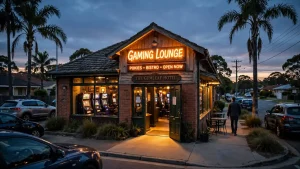
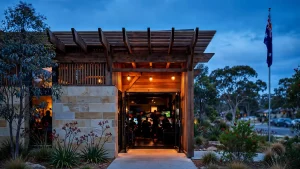
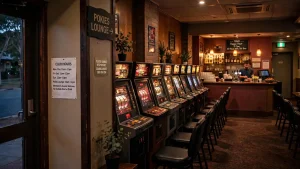
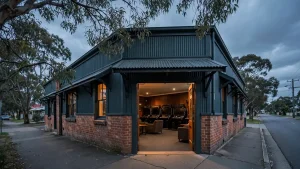
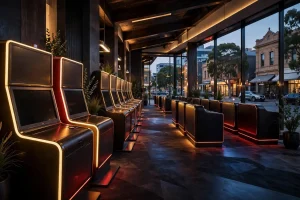
The phrase can describe gaming entertainment, but it does not identify an operator or prove that a website is a licensed Australian venue.
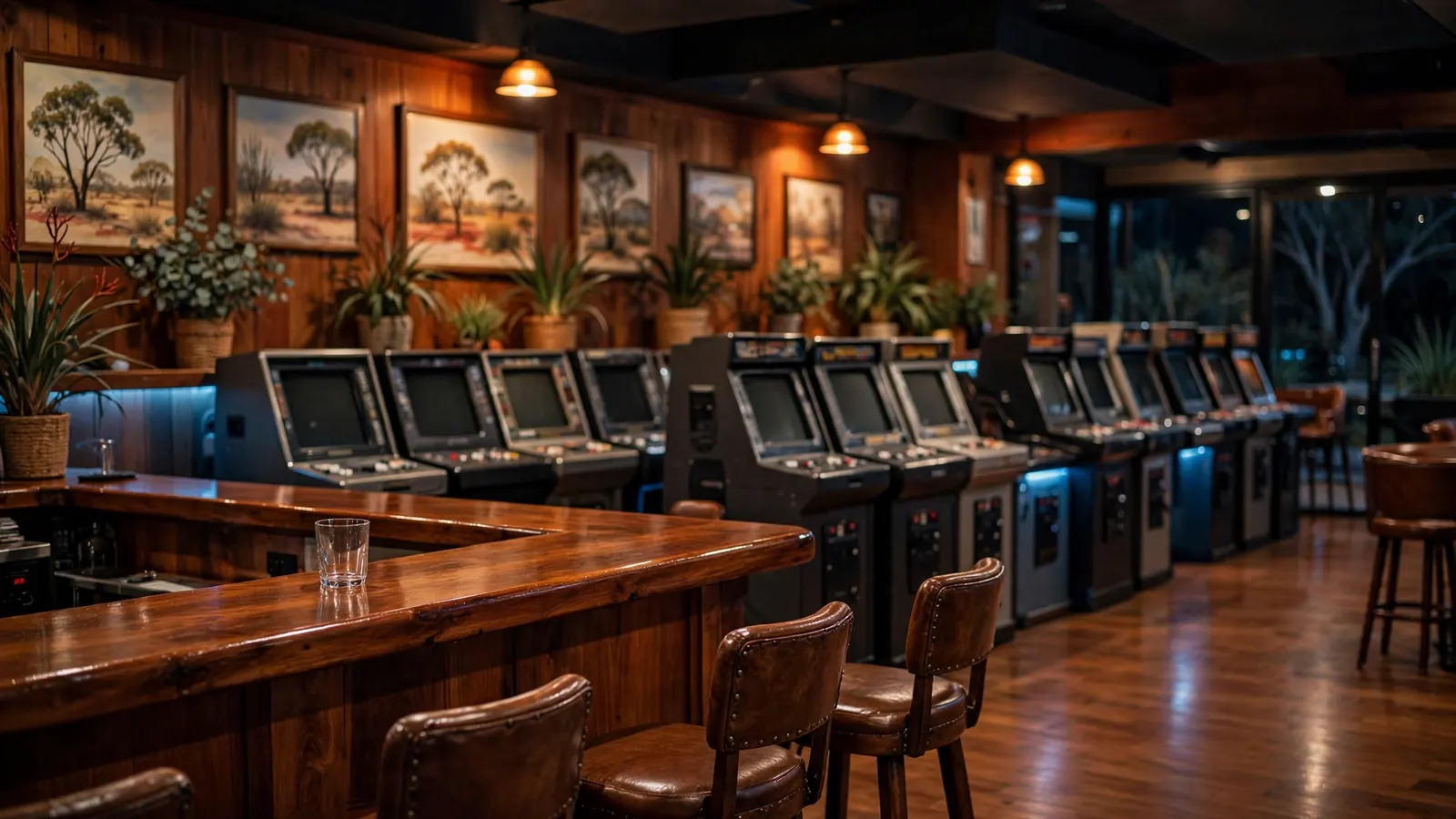
In Australia, “pokies parlour” is best read as an informal description, not as proof of a single national venue chain or a particular casino brand. The phrase can suggest a place where electronic gaming is part of the entertainment on offer. But the wording alone does not identify a specific operator, establish that a venue exists, or show that a website represents a physical casino.
That distinction matters because a land-based casino is a place with an address and an operating licence issued by the state or territory responsible for it. A website is a digital service. It may use words such as “parlour” or “casino” in its name, but those words do not turn it into a licensed Australian venue. The label is not the licence.
I learned to separate those two things early: a venue can be checked as a place, while a website has to be understood as a service. Treating the same phrase as if it meant both creates confusion before any other detail is considered.
Choosing a pokies parlour casino in Australia means weighing the details that matter to you, such as licensing, minimum deposits and payout methods. These notes highlight the specific information available for each listed operator.
7Bit Casino
7Bit Casino is operated by Dama N.V. and holds a Curacao license.
MrPacho
MrPacho lists a minimum deposit of A$30. Payouts take 30–120 minutes for crypto and 24–72 hours for fiat.
SkyCrown
SkyCrown is licensed by the Tobique Gaming Commission. Its stated payout times are around 10–15 minutes for crypto and 1–5 days for fiat, with a A$30 minimum deposit.
Wild Tokyo
Wild Tokyo has a Curacao license and a A$10 minimum deposit. Its stated payout times are 30–60 minutes for crypto and 1–5 days for fiat.
Uptown Pokies
Uptown Pokies has operated since 2017 and holds a Curacao license. Its stated minimum deposit is A$20.
Thor Casino
Thor Casino is licensed in Curacao by Antillephone N.V. for Versus Odds B.V. Its stated minimum deposit is EUR 20.
Roby Casino
Roby Casino is licensed by Curacao eGaming, with Roby Games Ltd named as the licensee.
Ricky Casino
Ricky Casino lists a A$20 minimum deposit, or A$30 to qualify for the bonus. Crypto payouts take under an hour, while PayID payouts take 1–3 business days.
GoldenCrown
GoldenCrown lists a Curacao Gaming Control Board license, OGL/2023/176/0095, held by Hollycorn N.V.
LevelUp Casino
LevelUp Casino holds a Curacao eGaming license, OGL/2023/174/0082, under Dama N.V. Its stated minimum deposit is A$15.
Australian casino properties are not interchangeable just because someone describes them with the same broad phrase. Lasseters Casino, for instance, is at 93 Barrett Drive in Alice Springs, in the Northern Territory. Jupiters Gold Coast Casino & Hotel is on Broadbeach Island on the Gold Coast. Country Club Casino is listed on Country Club Avenue, Prospect, in Meander Valley. Those are identifiable physical locations, not variations of a web address.
The examples also show why “parlour” should not be treated as a map category in its own right. A venue’s formal name and address provide a more reliable description of what it is than a generic label. When a phrase is used without a location or an identifiable operator, it may describe an idea of a gaming venue rather than point to a particular property.
All major Australian casinos operate around the clock. That fact describes their operating hours; it does not mean every business using similar wording is one of those casinos, or that every venue has identical facilities. The practical marker remains the physical property and the local licence under which it operates.
In the industry, names do useful work: they distinguish one property from another and connect it with its operating arrangements. A broad term such as “pokie parlour” does less. It can be used casually, or as part of promotional wording, without establishing who runs the business or where it is located. A familiar-sounding label is not a substitute for those particulars.
A website can present casino language, images or descriptions that sound like a physical destination. That presentation does not establish that the site is operated by a land-based casino, nor that it is an online extension of one. The same words can appear in a web address, a page title or a promotional name without identifying a licensed premises.
The reverse is also true: a real casino’s existence does not make every website using its name or similar language an official channel. The physical property and a digital service are separate things. A name may be shared, borrowed or imitated; the similarity itself proves nothing about the relationship.
This is where the phrase “parlour casino” can mislead. It sounds specific, but it may not tell a reader whether the subject is a venue, a directory entry, a review, or a website. In practical terms, the label needs a real-world anchor: an identifiable location and an operator accountable in the relevant state or territory. If the subject is only a webpage, that webpage should not be mistaken for a casino floor.
Australia’s framework for casino properties is jurisdictional rather than national: each property operates under a licence issued by its local state or territory authority. That is a feature of the physical casino market, not a general endorsement of any online service that adopts casino language. A website’s wording cannot borrow the standing of a venue simply by sounding related to it.
I have seen how easily presentation can blur the line. A polished page can make a phrase feel like a recognised venue name; an address can make a listing feel official. Yet neither appearance settles what the operation is. The useful distinction is plain: a land-based casino is a licensed property in a particular place, while a website is a digital service whose name and presentation must be assessed separately.
So, when “pokies parlour” appears in Australian casino wording, it should be understood as a loose description unless it is tied to a specific physical property. It does not, by itself, identify a national chain, a particular venue, or an authorised online casino brand. The location and the operator matter more than the label. A phrase can point in a direction. It cannot establish the destination.
A sign-up bonus can make an online casino page look like a formal invitation: create an account, accept an offer, then begin playing. In the Australian context, that presentation does not establish that the service is authorised here. The wording describes a promotion, not a licence. A no-deposit label changes the claimed entry condition; it does not change the legal status of the games or the operator.
That distinction is easy to miss because bonus language is built to make an offer feel immediate and specific. “No deposit” sounds like a low-risk trial. “Sign-up” suggests a standard account-opening process. But neither phrase tells a person where the operator is licensed, whether it may serve people in Australia, or whether the underlying service is lawful here. The offer and the authority to provide the service are separate matters.
 Best pokies in Melbourne: location and availabilityLearn what location searches can establish, why “best paying” claims need caution when outcomes are random, and why venue hours require direct…
 Best Casino in Melbourne: What to VerifyReview what a casino stay may include, which facilities and offers remain unverified, and why Australian online casino searches are a separate…
The federal law sets the relevant boundary for online casino products. The Interactive Gambling Act 2001 prohibits operators from providing real-money online casino games to people who are physically in Australia. That category includes casino-style games such as slots, poker and table games. An introductory bonus attached to such a service does not turn prohibited online gambling into an authorised Australian product. Nor does the absence of an initial payment make the promotion evidence of local approval.
I have seen promotional language do a lot of quiet work. It can make an account feel like a welcome, a reward, or a harmless test of a service. The important detail sits outside that framing: the promotion is attached to a particular operator and its gambling service. It cannot grant the operator a permission that the law does not provide. A polished page is still a page; an advertised offer is still an offer.
The same reasoning applies to phrases such as “Pokies Parlour sign-up bonus” or “no-deposit bonus.” A name that resembles a physical gaming venue does not establish that the website is that venue, connected to it, or covered by its local operating licence. Australia’s land-based casinos are licensed by their respective state or territory jurisdictions. Those venue licences do not extend automatically to online casino services using similar wording. The brand impression and the legal authority are not interchangeable.
Advertising is part of the issue, not a shortcut around it. Real-money online casino services cannot lawfully be promoted to Australian audiences. An offer displayed in Australian-facing material therefore cannot be treated as proof that the promotion has passed a local approval process. Its existence shows that a claim is being made; it does not resolve whether the service may legally make that claim or provide the games.
At the federal level, the Australian Communications and Media Authority, usually shortened to ACMA, oversees compliance with the Interactive Gambling Act 2001. Its remit includes monitoring whether online gambling services comply with the federal rules. Where a website provides prohibited interactive gambling services or advertises them in Australia, ACMA may ask Australian internet service providers to block access to it. That is a regulatory power, not a bonus-review process: the authority does not convert an offer into a licensed product by allowing a page to remain visible.
This is why the sign-up journey itself is a poor measure of legitimacy. A registration form, promotional banner or account screen can be designed to look routine. None of those interface details answers the legal question. From the operator’s side of the counter, an incentive is a way to attract attention and encourage account creation; it is not a document showing permission to serve a market. The distinction is plain, even when the page is not.
The phrase “no deposit” also needs to be read narrowly. It refers to the offer’s stated entry terms, not to consumer protection, Australian authorisation or the legality of playing. It does not mean that the operator is supervised by an Australian casino regulator, and it does not establish that an Australian resident may use the service. Promotional wording cannot carry that much weight.
The practical reading is therefore straightforward: treat a bonus claim as a marketing statement about an online service, not as evidence of an Australian licence. ACMA’s role is to enforce federal interactive gambling rules and monitor compliance, including action that can affect access to prohibited services. The legal status comes from the law and the operator’s conduct, not from the size, label or apparent ease of claiming an offer. A welcome message is not authorisation.
A site loading in a browser is a technical event, not a regulatory finding. The same is true if it accepts account traffic or appears at a different web address. None of those signs establishes that an online casino is authorised to serve people in Australia. I have seen how easily a working link can be mistaken for legitimacy: the screen looks finished, the account process continues, and the distinction between access and permission disappears.
The legal position is different from the appearance of the site. Under the Interactive Gambling Act 2001, operators cannot provide real-money online casino games to people in Australia. Casino-style services such as slots, poker and table games are prohibited when offered to customers here. A foreign licence, polished website or available login does not create Australian authorisation.
That boundary matters even when a page appears to offer a way to play without depositing money. The label on a page cannot settle its legal status, and being able to reach a particular address is not evidence that the service is permitted. The relevant issue is what the operator provides to people physically in Australia, not what its web design or account screen suggests.
ACMA, the Australian Communications and Media Authority, enforces the federal interactive gambling rules. It can ask internet service providers in Australia to block websites that provide prohibited interactive gambling services or advertise them. Blocking may affect whether a particular domain resolves through a local provider. It does not, by itself, transform the underlying service into a lawful one or provide a verdict on every page that happens to load.
A specialist gambling review has described ACMA blocking action involving Fair Go-related alternate domains. That is a reported enforcement example, not a general endorsement of any related address. The distinction is important: a new domain may appear after access to another one is disrupted, but a changed address is not a new Australian licence.
From the counter side, this is where the wording often does its work. “New address” sounds like a routine technical update; in practice, it may simply describe a different route to the same service. An alternate domain can be accessible at one point and fail to resolve later, depending on blocking and the provider. Availability moves. Legal status does not follow it.
I would not treat a page’s accessibility as a test of authorisation. Nor does a redirect, mirror page or account prompt answer the licensing question. Those features demonstrate only that a web address is reachable or that a page is responding; they do not establish permission to provide online casino gambling in Australia.
The practical distinction is plain. A physical casino operates under a licence from its state or territory jurisdiction. An online casino website is not made equivalent by using a similar name, displaying local language or remaining reachable through a changing address. For online casino services, Australian law prohibits operators from providing real-money play to people in the country.
A blocked address can therefore be a sign of enforcement rather than a temporary inconvenience with a legitimate substitute waiting elsewhere. Alternate addresses may come and go, and Australian internet providers may handle them differently as blocking takes effect. Neither outcome proves that a service has become locally authorised.
A working link is not a licence. A different address is not a licence either.
“Free” is a promotional label, not evidence that a particular casino venue provides a complimentary item. I have seen how easily a short phrase can do more work than the detail behind it: it suggests a benefit before establishing what is being offered, by whom, or in what setting. The wording alone does not confirm that free chips or spins are available at an Australian casino.
A physical gaming venue and an online promotion are different things. A phrase about free chips might refer to advertising for a website, a claim about a venue, or simply a broad description with no specific offer attached. “Free spins” points towards a different kind of promotional claim, but it still does not identify a provider or establish that a real offer exists. The terms are not interchangeable proof of a single product.
That distinction matters because an attractive label can leave the central question unanswered: what, precisely, is free? Without clear information identifying the provider and the item, the phrase cannot be treated as confirmation of a usable benefit. Nor does it establish that an offer belongs to a licensed land-based casino. A familiar casino-related phrase is not a venue record.
I treat the wording as a claim to be substantiated, not as a description that substantiates itself. “Free chips” sounds concrete, but the words do not name a specific item or show where it is available. “Free spins” carries the same problem: the promotional term does not establish a particular product, venue, or transaction. Attractive language first. Evidence second.
There is also a legal boundary around online gambling promotion in Australia. The Australian Communications and Media Authority, or ACMA, oversees compliance with federal interactive gambling rules and enforces the Interactive Gambling Act 2001. That role is relevant when promotional language points towards online casino-style gambling. The presence of a free-item claim does not turn a prohibited online service into a permitted one.
I would therefore keep two questions separate. First, is there a clearly identified offer, tied to a real venue or provider? Second, does the setting in which it is advertised comply with Australian law? A confident headline answers neither question by itself. The word “free” is particularly weak evidence: it describes the pitch, not the legal status or existence of the underlying offer.
For a land-based casino, a claim about a complimentary item should be connected to an identifiable venue and its own published information before it is repeated as fact. For online wording, the same phrase should not be mistaken for proof of an Australian-authorised casino product. A promotional label cannot supply that missing distinction.
This is why “pokies parlour free” language should be read carefully. It may combine a venue-like phrase with a promise, but that combination does not verify a free item at a physical parlour, or establish a lawful online offer. Specifics matter. Without them, it remains advertising language, not a confirmed benefit.
A useful review makes clear what it is reviewing. A physical casino and a website using similar language are not interchangeable subjects. When the distinction is blurred, a description of a venue can appear to endorse an online service, or a site’s claims can be mistaken for information about a real place.
I have found that the first test is simple: does the review identify a physical property and keep its observations tied to that property? Details about the setting, facilities or the experience of being on site belong to a venue review. Claims about account access, online play or a changing web address belong to a different subject. If a page moves between the two without saying so, its conclusions become difficult to rely on.
A polished presentation does not settle the question. Terms such as “official” or “trusted” are labels, not evidence of what the review actually examined. The useful detail is the scope: whether the writer visited or otherwise assessed a physical venue, or is describing an online service. If the page does not make that plain, the reader cannot tell which claims apply to which operation.
The licensing structure matters here. Australian casinos are regulated by the state or territory where each property operates, and each property holds a licence from its local jurisdiction. That is a venue-level framework. A review cannot substitute for the relevant jurisdiction’s licensing information, and a website’s description of itself does not show that it holds an Australian casino licence.
The same distinction applies to web access. A page loading successfully, processing account traffic or reappearing at another domain establishes only that the site can be reached in that instance. It does not establish Australian authorisation. A review that treats availability as proof of legitimacy has confused a technical fact with a regulatory one.
I also look at how a review handles uncertainty. A careful account separates what it observes from what it infers. It does not turn a venue’s name, photographs or familiar branding into proof that an associated website is the same business, or that both operate under the same permissions. Nor does a confident tone make a claim stronger. Keep the subject attached to the evidence.
This matters especially when a page uses “parlour” loosely. The word may appear in a headline, a venue description or a website’s branding. Those uses do not by themselves identify a separate licensed chain or establish that an online product corresponds to a physical casino. The review needs to say which one it means.
For a physical casino, the relevant licensing question belongs to the jurisdiction responsible for that property. For a website, physical access to a venue and the website’s online presence are not interchangeable credentials. A review that keeps those questions separate is more informative than one that combines them under a single reassuring label.
That is the practical standard I use: identify the subject, separate observation from assertion, and do not infer licensing from presentation or access. A review can help describe a venue. It cannot make a domain a licence.
A national picture of casino gambling cannot be reduced to one “parlour” or one city. Australia’s land-based market is spread across different jurisdictions, and a broad count of places with gambling is not the same as a count of casinos. The distinction matters: a city may have gambling facilities without each one being a casino, while a casino listing says little about the range of other venues in that city.
The country's largest gambling city with 11 gambling facilities.
Reports 3 casinos across 3 cities in the territory.
Has the largest city total in the Northern Territory with 1 casino.
One specialist casino review puts the number of Australian cities with gambling at 147. That is a snapshot reported by a review, not a permanent register: venue coverage and classifications can change. It is useful as an indication of geographic spread, but not as a definitive count of casino locations. The category is wider than casinos alone.
The same review identifies Sydney, in New South Wales, as the country’s largest gambling city and counts 11 gambling facilities there. That figure refers to facilities, not necessarily 11 casinos. The wording is significant. In venue listings, “gambling facility” can cover a broader set of places than a casino, so the number should not be repeated as a casino count.
The Northern Territory offers a smaller-scale example of how a regional count can be presented. A specialist review lists 3 casinos across 3 cities in the territory. In that same account, Alice Springs has the largest city total, with 1 casino. The phrasing may sound counterintuitive because the stated city total is only one; it indicates the highest count among the cities covered, not a large concentration. A regional comparison needs that context.
These figures are best read as a map of reported coverage rather than a ranking that settles where the market is busiest. The Sydney count concerns gambling facilities, the national count concerns cities with gambling, and the Northern Territory count concerns casinos. They use different units. Placing them side by side without naming those units creates a false impression of direct comparison.
The geography also explains why an Australian casino reference can point to very different kinds of places. A large metropolitan area and a regional city do not represent the same setting, and a national label does not make them interchangeable. Local licensing and venue arrangements sit beneath the national picture; the location of a facility matters, but the same broad phrase can hide substantial differences in what is being counted.
From behind a venue counter, lists were most useful when their labels were precise. A city count could help orient a reader, but it could not confirm what each listed facility offered or whether every entry was a casino. Those are separate questions, not details to infer from a map.
So the Australian picture is dispersed, but the headline figures need careful handling. Read the count as a count of its stated category, and the location as a location—not as proof that one parlour stands for the country. Small distinction. Big difference.
A bonus advertised as available to Australians is a claim about a promotion, not evidence that the service can lawfully provide online casino gambling here. Under the Interactive Gambling Act 2001, operators cannot offer real-money online casino games to people in Australia, and advertising those services is also prohibited. A polished offer can still sit on the wrong side of that boundary.
Enforcement leaves a visible trail. Since November 2019, the Australian Communications and Media Authority (ACMA) has used enforcement action to block more than 1,455 websites connected with illegal gambling, including affiliate sites. The total is a measure of action over time, not a directory of every service that may appear under a new address. Blocking can remove a route to a site without making its promotional claim legitimate.
There is also a reported difference in the number of services that have left the Australian market. One figure puts withdrawals at more than 210 since ACMA enforcement began in 2017; another reports more than 190 over the same period. Those counts do not match, so neither should be presented as an uncontested total. Both describe services withdrawing, not a blanket finding about every website currently carrying a bonus message.
That distinction matters when a “pokies parlour bonus” is framed as a local offer. The language may borrow the atmosphere of a physical gaming venue, while the promotion itself relates to an online service. Enforcement figures show that blocking and withdrawals have occurred at scale; they do not certify an individual offer, nor do they turn an online casino promotion into a lawful Australian product.
From the counter side, the promotional wording is often the part designed to travel furthest: it can be copied across pages even after the underlying access route changes. A blocked domain may stop resolving through an Australian provider, while another address later appears. Neither the old address nor the new one proves that a bonus is authorised. A campaign can remain visible after the service behind it has become harder to reach.
The practical reading is plain: claims about a free or cashable reward do not override the legal status of the service advertising it. ACMA’s blocking record and the reported withdrawals describe enforcement outcomes, not endorsement. Marketing language is not a licence.
“VIP” is a label, not a description of a confirmed casino service. In venue material, it can sound like a defined status with particular access or benefits; without a specific, substantiated venue policy, the word tells little about what is actually available. I learned to separate the presentation from the operating detail. A polished label does not establish a membership scheme, a dedicated room or special entry conditions.
The same distinction matters when “VIP” is attached to a parlour casino. The phrase alone does not identify a particular Australian venue or verify that it offers a VIP programme. Nor does it establish who can qualify, what any status includes, or whether such an arrangement exists at all. Those details need to come from reliable information about the named physical venue, rather than being inferred from the label.
There is one clear baseline for casino entry across the country: the minimum age is 18. That is an entry threshold, not a VIP rule. It does not prove that a venue has a separate VIP area, and it does not tell anyone what additional conditions a particular venue might apply. Age eligibility and premium access are different matters.
Across Australia, the minimum age for casino entry is 18. This is a nationwide entry threshold and not a VIP rule.
That distinction is easy to lose in promotional wording. “Exclusive” can imply scarcity; “VIP” can suggest a package of privileges. Neither word, by itself, supplies the practical terms behind the impression. In venue operations, those terms only mean something when a specific policy defines them. Otherwise, they remain claims of tone, not evidence of a service.
So the grounded point is narrow: casino entry has a nationwide minimum age of 18, while VIP access cannot be assumed from a search phrase or label. No more than that.
The national figure for casino gaming machines is 3,308. It counts machines that are both installed in Australian casinos and endorsed on venue licences. That makes it a measure of licensed casino capacity, not a count of every gambling machine in the country or of standalone gaming venues.
I have found that a single total can sound more revealing than it is. It gives a useful sense of scale, but says nothing by itself about how machines are distributed between properties, how many are operating at a particular time, or what facilities a particular venue provides. Those questions require venue-level information; the national count cannot answer them.
The wording of the figure matters. A machine being installed and covered by a casino venue licence places it within a defined land-based setting. It is not a catalogue, a recommendation, or evidence that every casino offers the same experience. Nor does the total establish the number of machines available in any particular city or parlour.
In practice, I would treat 3,308 as a boundary around one category: machines recorded in Australian casinos under venue licensing. It is a useful piece of context when assessing the scale of casino gaming, but it should not be stretched into claims about individual venues or the wider gambling market. A national total is not a venue profile.
That distinction is easy to miss in promotional language, where a large figure can be made to suggest abundance or uniformity. The licensing count is narrower and more concrete: it concerns machines installed in casinos and endorsed on their licences. It does not describe their features or establish what is available at a given property.
A defined count. Not a catalogue.
“Real money” changes the meaning of an online casino claim. It signals that deposits, wagers and cash outcomes are involved, not simply a digital game presented for entertainment. In Australia, that distinction has a legal consequence: the Interactive Gambling Act 2001 prohibits operators from providing real-money online casino games to people physically in the country. That includes casino-style games such as slots, poker and table games.
I have seen the wording on a page do more work than the evidence behind it. A site may describe play as real-money, take account traffic or be reachable through a particular address. None of those signs establishes that it holds an Australian casino licence. They show what the site claims or does, not that its online casino service is authorised here.
The word “licensed” can also be slippery. An overseas licence, if a site claims one, is not the same as permission to provide online casino games to people in Australia. Nor does a polished registration process change the legal position. Presentation is not authorisation.
A physical casino and an online service are not interchangeable simply because both use casino language or involve money. State and territory jurisdictions license land-based casino properties; the federal law sets the boundary for prohibited online casino services. The venue’s licence does not transfer to a website using similar branding or wording.
That is the practical limit of a real-money claim: it can describe the service being offered, but it cannot prove Australian approval. Accessibility is not proof. Neither is an account page.