Compatibility depends on a game's underlying software, while Australian real-money play and promotional claims require separate scrutiny.
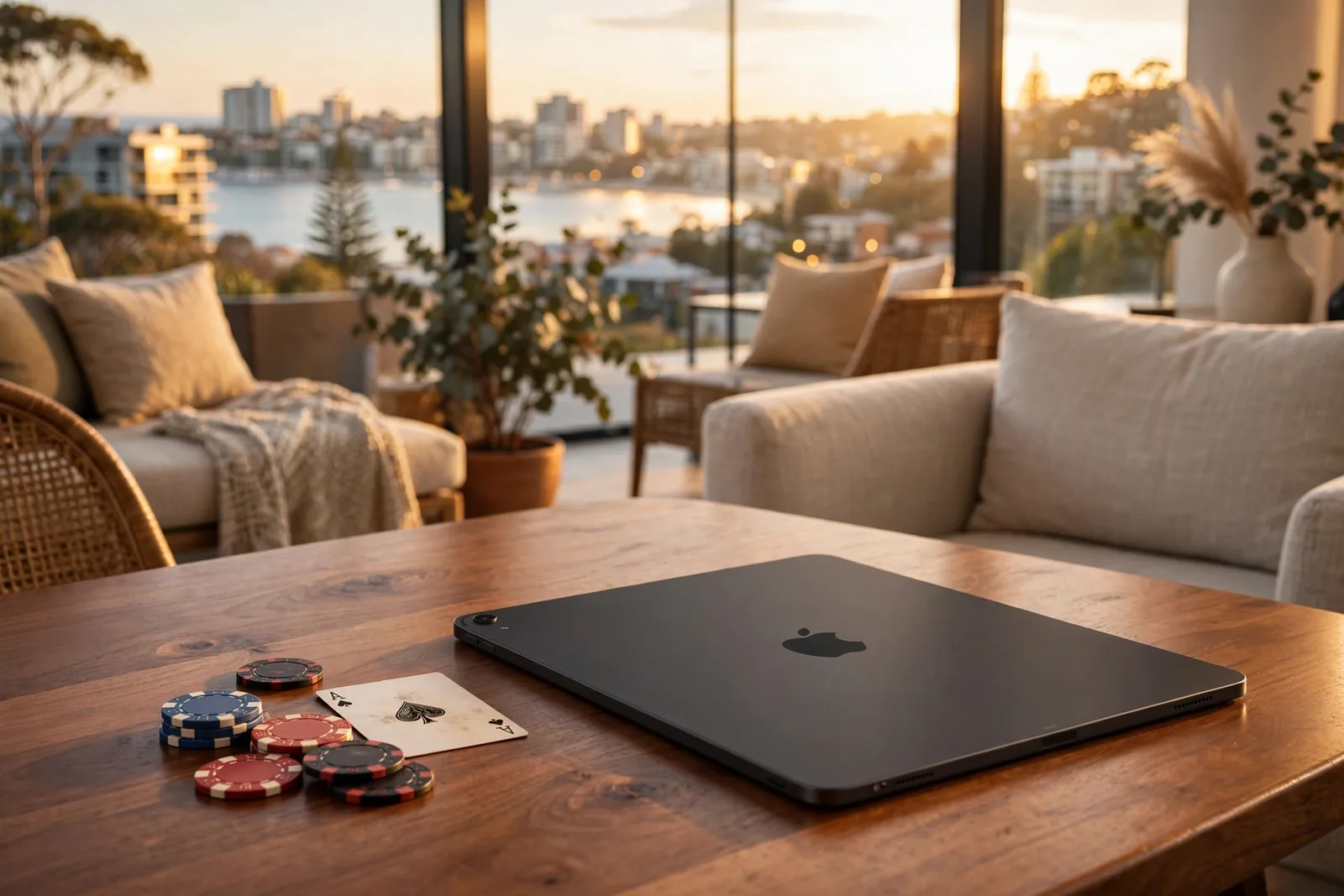
An iPad can handle many kinds of interactive content, but that does not mean every casino-style game designed for the internet will work on it. Compatibility depends on how the game was built and whether its software can run in the iPad environment. The result is a device experience with real limits: some titles may be unavailable, and the selection offered for iPad can be narrower than the broader range associated with online casino play.
The technical gap is not always obvious from a game’s appearance. A title may look suited to a touchscreen yet rely on older software behind the interface. Flash is one example. It was used for many internet casino games, including some table-game formats, but Apple devices and Flash have had a difficult relationship. Where a game depends on that technology, it may not run on an iPad. A familiar screen design is no guarantee of compatibility.
That distinction matters because “made for the internet” and “works on an iPad” are not interchangeable claims. A game can be available in a general online catalogue while remaining inaccessible on a particular device. Compatibility is determined by the software underneath, not simply by whether the screen looks like it could be tapped. The iPad’s capabilities do not automatically resolve a developer’s choice of technology.
The device-specific range can also lag behind the wider catalogue. Some developers still need to adapt their online games and gaming rooms for iPad use. Until those versions are ready, the iPad selection remains smaller. This is a development issue, rather than a sign that the tablet cannot display interactive games at all. The distinction is useful: an absent title may reflect unfinished adaptation, not a fault with the tablet.
From the industry side, this kind of gap often sits between a product being designed and its delivery across devices. A desktop-oriented game may need changes before it can work properly in a mobile environment. Those changes can affect more than the size of buttons. The interface, the way information is arranged, and the underlying software all have to suit the device. A version that has not been adapted can be difficult to run—or may not be available.
That makes broad claims about an “iPad casino” imprecise. The phrase can describe a general idea, but it does not establish that every game in a catalogue will load or behave as intended on an Apple tablet. The practical question is not just whether casino-style content exists online; it is whether the specific software has been made compatible with the iPad. There is no single answer that applies to every title.
A smaller selection also changes what “available” means in practice. A catalogue may contain many games overall, while only a portion has versions suited to the iPad. Developers may release adaptations at different times, and some may not make them at all. That leaves a mismatch between the breadth of a general catalogue and what can actually run on the device. More titles on a service’s desktop version do not necessarily translate into more choices on a tablet.
It is tempting to treat a missing game as a temporary glitch and keep trying the same approach. Sometimes the limiting factor is not a setting that can be changed, but the game’s reliance on software that does not work with the iPad. Repeatedly reopening a page cannot make an incompatible format compatible. A technically sound tablet can still be the wrong environment for a particular piece of older or unadapted software.
The reverse is also true: the fact that some games do not work does not mean an iPad is incapable of interactive casino-style play as a category. The available range is simply more constrained, and individual compatibility depends on development choices. That is why a general statement that online casino games run on iPad can overpromise. Some may; others may not. The difference lies in their implementation.
In practical terms, an iPad offers access only where the software and its adaptation meet the device’s requirements. Flash-based titles can present a particular obstacle, while the broader catalogue may be reduced because developers have not finished iPad versions of every game or room. Those are separate limits: one is a compatibility problem, the other a matter of availability. Both shape the experience before questions of preference even arise.
For anyone assessing casino-style content on a tablet, the sensible baseline is modest: expect variation, not universal compatibility. A game’s presence in an online catalogue is not proof that it will run on an iPad, and a smaller iPad range is a consequence of both technical support and the pace of adaptation. No technical shortcut. 18+ only. Gambling can be harmful; seek support if it is causing problems.
Interest in free pokies on an iPad often combines several different ideas: a familiar Australian-style game, a version that works on a tablet, and a way to play without depositing money. Those ideas are not interchangeable. A game may be designed for touchscreens without being free to play; a free demonstration may exist without being an iPad app; and a title associated with a particular developer is not automatically available in every format.
That distinction matters especially for Aristocrat. The name may come to mind when people think of Australian pokies, but it does not establish that a particular Aristocrat title is available for iPad, that it has a free mode, or that a service offering it is genuine.
“Free” is also a slippery label. In entertainment software, it can mean an installation costs nothing, a game has a demonstration mode, or access is supported by advertising or other conditions. It does not necessarily mean a person receives cash, can withdraw a balance, or can use every feature without payment. The label alone explains very little. Fine print does the work.
The iPad adds another layer. The range of Australian online casino games available on the device can be narrower than the wider range associated with casino-style play. Some developers are still adapting their online games and game rooms for iPad use. That process can affect which versions exist and how they behave, but it does not identify a specific Aristocrat product or prove that any particular free pokies catalogue is available.
I have seen how a broad category label can make an offer sound more settled than it is. “Pokies for iPad” might describe a mobile-compatible game, a web page dressed up as an app, or simply a general claim about a service. “Free” may describe only the initial access. Without clear product details, those phrases should not be treated as proof of a specific title, developer, device version or play mode.
A list implies that named apps have been identified and assessed. It would also imply that they are genuinely free in a defined sense and work on the device in question. A ranking cannot fill in missing product particulars.
The same caution applies to free-play websites and downloadable apps. A product’s name, appearance or use of a familiar category does not verify its relationship to Aristocrat. Nor does the word “download” prove that an app is available through an official channel or that it contains the expected game. A polished page can still leave essential details unclear. Presentation is not verification.
A more precise description separates the claims. One claim concerns whether a game has been adapted for iPad. Another concerns whether the game is associated with Aristocrat. A third concerns whether there is a free mode, and what “free” means in practice. Treating those as separate questions avoids turning a broad search for free Aristocrat pokies into an unsupported recommendation.
There is a further practical distinction between a game being playable on a tablet and a dedicated app being available. A browser-based experience and an installed app are different forms of access; neither, by itself, confirms the developer or the terms of play. That is a question of access method, not evidence that a particular free product exists.
The useful conclusion is narrow. Some developers continue to adapt casino-style games and rooms for iPad, while the range available on the device remains smaller. That explains why availability can differ from one format to another. It does not establish a catalogue of free Aristocrat pokies, a set of downloadable titles, or a verified free-play service. The distinction is simple. Claims need particulars.
Choosing an iPad casino in Australia for 2026 means checking practical details as well as the operator’s credentials. Use these short verdicts to see which verifiable details are available for each option.
7Bit Casino
7Bit Casino is listed as operating under a Curacao licence through Dama N.V.
MrPacho
MrPacho lists a minimum deposit of A$30. Its stated payout times are 30–120 minutes for crypto and 24–72 hours for fiat.
SkyCrown
SkyCrown is licensed by the Tobique Gaming Commission and has a A$30 minimum deposit. Stated payouts take around 10–15 minutes for crypto and 1–5 days for fiat.
Wild Tokyo
Wild Tokyo has a Curacao licence and a A$10 minimum deposit. Its stated payout times are 30–60 minutes for crypto and 1–5 days for fiat.
Uptown Pokies
Uptown Pokies has operated since 2017 under a Curacao licence, with a minimum deposit of A$20.
Thor Casino
Thor Casino is licensed in Curacao by Antillephone N.V. (Versus Odds B.V.). Its listed minimum deposit is EUR 20.
Roby Casino
Roby Casino is listed as licensed by Curacao eGaming, with Roby Games Ltd named as the operator.
Ricky Casino
Ricky Casino lists a A$20 minimum deposit, rising to A$30 to qualify for the bonus. Stated payouts are under an hour for crypto and 1–3 business days for PayID.
GoldenCrown
GoldenCrown lists a Curacao Gaming Control Board licence, OGL/2023/176/0095, held by Hollycorn N.V.
LevelUp Casino
LevelUp Casino is licensed by Curacao eGaming under OGL/2023/174/0082, with Dama N.V. named as operator. Its minimum deposit is A$15.
“Best” sounds like a verdict, but it only helps when the criteria behind it are clear. A ranking can make several services look directly comparable even when the important differences are about how their interfaces feel on an iPad. I would start with the experience the device actually presents, not with a badge or a broad claim of quality.
Software designed for mobile use is adapted from the kind of programs also used by desktop customers. Its interface is made more suitable for touch, and its text and controls are arranged for readability on a mobile screen. Those are practical design choices, not proof that one service is better in every respect. A page may be legible yet awkward to navigate; large controls may be easy to tap but leave less room for useful information.
That is why a useful comparison needs to separate distinct questions. Is the interface readable without constant adjustment? Are controls recognisable and comfortable to use by touch? Does moving between sections feel coherent, or does the layout make simple tasks harder? These are observations about design. They do not establish that a service offers a wider range, works in every circumstance, or deserves a universal “best” label.
The distinction matters because promotional language often compresses several claims into one word. “Best” may suggest excellent presentation, broad choice, a smooth experience, or simply a prominent position on a page. Those meanings are not interchangeable. A polished interface says something about presentation; it does not, by itself, settle the other questions. Marketing likes a single answer. The device does not.
When I compare experiences, I treat readability and touch response as separate from the content displayed on screen. Clear labels and a layout that responds sensibly to taps can make an interface easier to use. But a screen that looks orderly at first glance may still make important information difficult to find. The comparison should describe what can be observed, rather than turn a visual impression into a sweeping judgement.
There is also a difference between “best on iPad” as a personal fit and “best” as a claim that one option outranks all others. A person who values uncluttered navigation may judge an interface differently from someone who values dense information on screen. A ranking hides that choice unless it explains the standard it uses. Without a stated standard, the order is decoration.
I would therefore read any iPad-focused comparison as a set of criteria, not as a league table. The most defensible points are concrete: how well the layout uses touch, whether text remains readable, and whether the interface presents its controls clearly. A comparison should also distinguish what it has actually assessed from what a headline merely implies. That is less dramatic than a winner, but more useful.
The phrase “best iPad casino app” can imply a device-specific advantage. Yet the meaningful question is not whether a label sounds tailored to Apple’s tablet; it is whether the interface has been adapted for mobile use in a way that supports legibility and touch. Even then, the conclusion should stay narrow. Good mobile presentation is a design quality, not a guarantee of overall suitability.
The same restraint applies when a page presents a “best” choice for an iPad. A ranking without clear criteria gives no way to tell whether the order reflects readability, touch-friendly design, or something else. A short explanation of the comparison standard carries more weight than a confident label. I have seen how easily a headline can outrun the detail beneath it. The wording is easy; the judgement takes care.
For an iPad, then, “best” is most useful as a description of fit: an interface that is readable and designed around touch, assessed against stated criteria. It should not be treated as a universal verdict, and a ranking alone cannot show why one experience suits a particular use better than another.
18+ only. Gambling can cause harm.
A format built around several tables or several balls asks more of an iPad screen than a single, self-contained game. Each part of the action competes for space: the play area, controls, status information and any view of what is happening elsewhere. On a compact display, keeping those elements visible together can become the main difficulty.
I have found that the problem is not simply whether a page fits on the screen. It is whether the important parts remain legible and usable at the same time. A layout can technically display several play areas while leaving each one too small to follow comfortably. Enlarging one area may push another out of view or require repeated switching between panels. That changes the task from following the game to managing the screen.
Multi-table play makes this trade-off easy to see. The format relies on attention moving between separate areas, but a tablet cannot provide the same physical viewing space as a larger display. A person may have to choose between seeing more of the overall layout and seeing one part in enough detail. Neither view is necessarily ideal.
Multi-ball formats create a related, though distinct, demand. Several moving elements can require attention at once. When the active area is small, movement and controls have less room to breathe visually. The result may feel crowded even when the software has been adapted for touch. A larger interface button can help with tapping, but it cannot create more screen space for the action itself.
This is why “iPad slots” is not a single experience. A straightforward, one-area layout places fewer demands on screen space than a format that asks the player to track multiple tables or balls. The relevant distinction is the shape of the interface, not a claim that every game of a particular category will behave the same way.
The iPad can also be held in different orientations, but changing orientation is not a cure for every layout. A wider view may give separate areas more horizontal room; a taller view may make controls or information easier to arrange. The software determines what is actually visible and how the interface responds. More width in one direction can mean less room in another.
A useful assessment is therefore practical: can the active area be followed without constant resizing, can controls be reached without obscuring play, and can secondary information be checked without losing track of the main action? If the layout depends on watching several places at once, the smaller display is a real constraint, not a minor matter of preference.
There is no universal workaround. A format designed around multiple simultaneous views may remain awkward on an iPad, even when its interface is touch-friendly. Screen limits are physical. That is the trade-off.
18+ only. Gambling can cause harm.
An iPad changes the way a casino-style game is displayed; it does not change the law governing who may provide that game. Under the Interactive Gambling Act 2001, operators are prohibited from offering real-money online casino games to people in Australia. The restriction applies to online casino services provided to people physically in the country, including games presented as mobile or tablet experiences.
That boundary matters because the device can make access feel ordinary. A page may fit the screen, buttons may respond to touch, and a game may appear to work much like other mobile entertainment. None of those interface details makes the underlying real-money service lawful to provide in Australia. The legal question is not whether the software runs on an iPad. It is whether an operator is supplying a prohibited online casino service to someone in the country.
The Act was amended in 2017, with the prohibition on providing online casino games to people in Australia made explicit. The relevant distinction is between the operator supplying the service and the individual using a device. Australian online gambling rules primarily target supply; they do not impose player liability for accessing an offshore casino. That is a distinction about whom the law addresses, not an endorsement of offshore play or a statement that a service is safe, dependable or available.
I have seen how presentation can blur that distinction. A label such as “iPad friendly” describes a user interface, not legal authorisation. “Real money” describes the stakes, not a separate legal category that bypasses the restriction. Free access and promotional wording can raise different questions from wagering, but they do not turn an operator’s prohibited real-money service into a permitted one. The screen is not a loophole.
The Australian Communications and Media Authority enforces the prohibition. Its actions include blocking offshore gambling websites and pursuing legal action against operators that target Australian players. Blocking is a practical intervention: a domain may stop loading from within Australia, even if it remains visible elsewhere. A broken page does not necessarily mean a device problem, and changing how a page is opened does not alter the law that applies to the service.
A specialist review reported that ACMA added more than 500 domains to its block list in 2025. That figure belongs to that reported period; it is not a promise about what will be blocked next, nor a complete measure of enforcement. The broader point is narrower: access to offshore sites is actively subject to blocking, and enforcement is directed at prohibited services and their operators. Availability can change. Legal status does not follow the changing address.
This is why a search for real-money casino play on an iPad cannot be treated as a straightforward device-shopping exercise. A working mobile layout answers only a technical question. It does not establish that the operator may lawfully offer the service in Australia. Nor does an offshore licence, where one is claimed, replace permission to provide a service that Australian law prohibits. Licensing language can sound reassuring while leaving the central Australian restriction untouched.
The same separation applies to claims about an account, a bonus or a payment route. A promotion is not proof that the underlying service is permitted. A payment method is not a legal approval. These details may affect how an operator presents its product, but they do not change the rule against providing real-money online casino games to people in Australia. No interface feature or marketing label changes the supply boundary.
My own mistake early on was to read smooth access as evidence of legitimacy. It was only evidence that a page loaded at that moment. In this market, access, technical compatibility and lawful provision are separate questions. Confusing them is easy; the consequences of the confusion are not evenly distributed, because the law is aimed chiefly at the supplier rather than the player.
18+ only. Gambling can cause harm.
“No deposit” sounds like a complete description. It is not. The phrase signals a promotional claim about how an offer is presented; on its own, it does not establish what is being offered, who can access it, or what conditions apply. The wording should not be mistaken for proof that an iPad casino bonus or a bonus connected with pokies is available.
That distinction matters because promotional language compresses details. A label can attract attention while leaving the operative terms elsewhere—or leaving the offer’s status unclear. Without a clearly stated, applicable set of terms, there is no sound basis for treating a no-deposit claim as a usable benefit. The phrase is the headline, not the agreement.
I have seen how easily the headline takes over the decision. “Free” feels definite; the mechanics underneath are what determine what the claim actually means. A bonus label alone cannot answer that. No shortcut there.
For iPad play, the device does not change the meaning of a promotion. A claim described as an iPad casino no-deposit bonus is still a promotional claim, not confirmation that a particular offer applies to the device or to someone in Australia. The wording may combine a device, a game category and a bonus promise, but combining those terms does not verify the underlying offer.
There is a separate issue that promotional language cannot resolve. The Interactive Gambling Act 2001, amended in 2017, prohibits providing online casino games to people in Australia. That legal boundary concerns the provision of the service; it is not a bonus condition and cannot be softened by describing access as free or without a deposit. A promotion does not turn a prohibited service into a permitted one.
This is why a no-deposit claim should not be read as a recommendation or an invitation to register. The phrase does not establish that a service is lawful to provide in Australia, nor does it establish the terms of a specific offer. Those are different questions, and a promotional label answers neither by itself.
The distinction is especially important when bonus language is paired with “pokies” or “iPad.” Such wording can sound tailored and concrete, yet it remains a claim about an offer. The device named in the wording does not supply missing terms, and the word “no” does not remove the legal restriction on providing online casino games to people in Australia.
18+ only. Gamble responsibly.
An iPad casino app and a casino site opened in Safari are two different routes to a mobile interface. The distinction is practical: one is installed software, while the other loads through the browser. Neither route, by itself, tells much about the quality of the experience or whether a particular service is appropriate for someone in Australia.
Apps designed for iPad use are adapted from software built for desktop customers. The controls are arranged for touch rather than a mouse, and text and menus are adjusted for a smaller display. That can make navigation feel more direct than using a desktop layout scaled down to fit. Installation is a separate step, though. An app must be offered for the device and accessible through an appropriate distribution channel; a page describing an app does not establish either point.
Browser access avoids installing a separate program. Casino sites commonly provide mobile versions that open in an iPad browser, with page elements arranged to fit the screen. The browser remains the access layer: it loads the site, and the site supplies its own controls and content. If a page is poorly adapted, the result can still involve awkward menus or text that is difficult to read. Having a mobile site does not guarantee that every part of it works equally well on every iPad.
From the operator’s side, an app can provide a more controlled interface, while a browser site can reach users without asking them to install dedicated software. From the user’s side, the difference is often less dramatic than the labels suggest. Both depend on the device, the software being maintained and the layout being suited to touch. The word “app” is not a quality mark. Just a delivery method.
An iPad casino app is installed software with controls arranged for touch, whereas browser access loads via Safari and depends on the site's own mobile adaptation. Neither method serves as a quality mark or legal endorsement.
I treat “top” or “best” app claims cautiously. A polished interface says something about presentation; it does not verify a product, its terms or its suitability. The same applies to a mobile browser page. Familiar branding and a smooth sign-in screen are not substitutes for checking what is actually being offered—and in Australia, access mechanics should not be mistaken for permission to provide online casino gambling.
For a straightforward comparison, the useful questions are narrow: does the interface respond sensibly to touch, is the text readable without constant zooming, and can the same basic navigation be completed in the browser? Those are observations about design, not recommendations for a casino app. Browser access and installed software remain different routes to a screen, not endorsements of what appears on it.
18+ only. Gambling can cause harm.
An iPad’s mobile browser can open mobile-formatted websites without installing a separate app. Nearly all online casino sites have a mobile version designed to work in an iPad browser, and browser access is also how many Australian mobile casino sites are reached. That describes a technical route, not confirmation that a particular site or free-play product is available.
In practice, a page may rearrange its menus and controls for a touch screen, but browser compatibility alone says little about what appears after it loads. A site may present information, account prompts or game content differently across devices. The browser can render a mobile site; it does not certify the content, the operator or any claim that access is free.
I have seen “free” used as a broad label, when the important distinction is whether a specific feature is actually accessible without payment and what conditions surround it. Without a named, checked product, the label cannot be treated as proof of a working free casino experience on iPad. No product list follows from compatibility.
There is a further boundary: technical access must not be confused with permission to provide real-money online casino games in Australia. A mobile page loading successfully does not change the rules governing those services. Browser support is not approval.
So the useful conclusion is narrow: the iPad browser can display mobile casino sites, but that fact does not verify any particular free offering or make it suitable for use. Access method only.
18+ only. Gambling can cause harm.
An iPad can be associated with several familiar casino categories, but that does not make every app or title suitable for the device. Blackjack, craps and baccarat are among the established formats commonly considered for iPad play. That broad observation says nothing about a particular app’s quality, availability or terms.
I have learned to treat “best” as a label that needs a clear basis. A polished icon or an app-store description cannot establish how a game behaves on an iPad, whether its controls are legible, or what its access conditions are. Those details belong to the individual product, not to the category. Category fit is not a product assessment.
The same distinction matters when a game is described as “free.” The word may refer to access without payment, but it does not, by itself, explain what features are included or how the experience is structured. A label is not the whole offer. No title should be treated as an endorsed choice merely because it appears in a list or carries a familiar casino-style name.
Slot-machine searches often lead to app pages and promotional descriptions that make confident claims. I read those as descriptions, not independent proof of how a product performs on an iPad.
The useful distinction is simple: popular casino formats can be discussed at category level, while claims about a specific game need product-level evidence. Keep the two apart. No guesswork.
No—operators are prohibited from offering real-money online casino games to people in Australia, whether they play on an iPad or another device. The law targets operators rather than players, and ACMA blocks offshore gambling sites.
Blackjack, craps and baccarat are good options for iPad play. Some games may not be available because of compatibility limits or because they have not been adapted for the device.
Mobile versions are adapted for touch controls and easier reading on a smaller screen, but the iPad selection can be narrower than the desktop catalogue. Multi-table and multi-ball games may also be harder to play on the tablet’s smaller display.