A practical look at browser access, account security, Australian legal exposure, bonus conditions and what comparisons can—and cannot—establish.
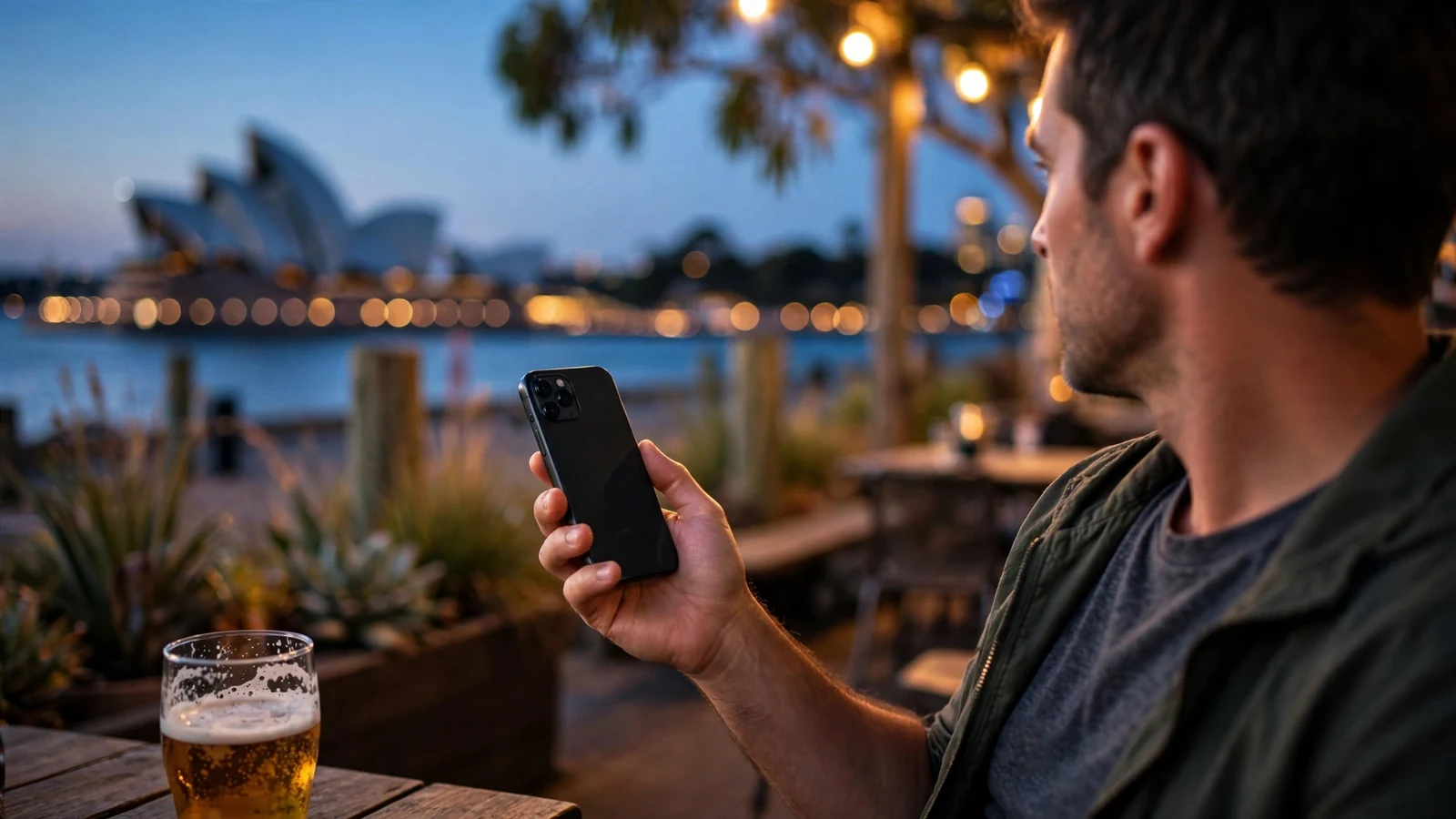
For Australian users, mobile access to offshore casino sites is generally a browser task, not an app-store download. Casino apps are rarely listed on Google Play or the Apple App Store in Australia, so the usual route is to open the operator’s website in a mobile browser. That arrangement can look less like a dedicated app, but it is the standard way these sites are reached on a phone.
In practice, the browser version is often the same account environment used on desktop. A punter can sign in through the mobile site rather than creating a separate mobile profile, and the account remains the point of continuity between devices. The interface may be arranged for a smaller screen, while the underlying login is shared. The distinction matters: a mobile-friendly website is still a website, even when its layout feels app-like.
I have seen people assume that a casino must have an app because its pages appear polished on a phone. That is not a reliable distinction. A responsive website can fit a mobile display without being installed at all. It opens in the browser, and the browser remains the route back to it. With an offshore online casino, that is often the simplest explanation for mobile access in Australia.
Browser play requires no app-store listing. The site is opened directly in the mobile browser, and the user signs in with the account already used on desktop. The practical benefit is continuity: there is no separate mobile account to manage simply because the device has changed. The practical limitation is equally plain: access depends on returning to the website in the browser, rather than opening a conventional app from the home screen.
That difference can sound minor, but it affects how people understand what they have installed, or have not installed. A casino page saved in a browser is not necessarily an app. It may only be a bookmark or an open browser tab. The account remains on the casino’s website, and the browser is the doorway.
This is why descriptions such as “mobile casino” can obscure the format. The phrase may refer to a site designed to work on a phone, not a native application downloaded from a store. In the Australian market, browser access is the default because store-listed casino apps are uncommon. The most straightforward route is often the least visible one: a browser window.
Some casinos that accept Australian players also provide a Progressive Web App, or PWA. This is not the same thing as a native app distributed through an app store. A PWA is a website configured so it can be placed on a phone’s home screen and opened in a more app-like manner. The site remains the underlying service; the home-screen icon is a shortcut to it.
Installation begins on the casino’s website. If the site presents an install or add-to-home-screen prompt, the user can tap it and confirm. The resulting icon gives a direct way to reopen the site, rather than requiring the address to be entered or a bookmark to be found each time. In everyday use, that can make the website feel closer to a native app, even though it began as a browser-based service.
The distinction is useful because “installed” does not necessarily mean “downloaded from Google Play or the Apple App Store”. A PWA is added through the website’s own prompt. It can behave like an app on the device, but its origin is still the casino website. The label describes the experience, not a separate store product.
I would treat the prompt as a convenience feature, not proof that a site has a conventional mobile application. The crucial detail is how the icon was created: through a website prompt, rather than a store listing. That is the practical difference between browser access with a home-screen shortcut and a native app.
For someone comparing offshore casinos online, the mobile format is usually a choice between opening the site in a browser and saving its PWA shortcut. Browser use keeps the process simple and makes the website easy to close when finished. A PWA makes repeat access more direct by putting an icon on the home screen. Neither option requires a separate account when the mobile site uses the same login as desktop.
The word “app” is often used loosely in promotional language. In this context, it may mean a PWA rather than software obtained from an app store. That distinction is easy to miss when both routes produce an icon and an app-like screen. The label is less informative than the installation path.
For an Australian mobile user, then, the expected pattern is browser first, with a PWA available at some sites as a shortcut. A conventional casino app is not the default, since these apps are rarely present in the major mobile stores locally. The underlying experience is still website access, whether it is opened in a browser or launched from a home-screen icon. Clear distinction.
For Australian punters, the practical choice is usually between opening a casino website in a mobile browser and adding that website to the home screen as a Progressive Web App (PWA). Native casino apps are rarely listed on Google Play or Apple’s App Store in Australia, so browser access remains the default. The distinction matters: a PWA can look and feel app-like, but it is still a route into the website rather than a separately downloaded store app.
In browser play, the site opens in the phone’s browser and the account is generally the same one used on desktop. That makes the format straightforward: there is no separate casino account to manage just because the device has changed. The interface is delivered through the website, and the punter returns to it by reopening the browser or using a saved bookmark. It is the least complicated starting point because no installation step is needed.
A PWA adds a shortcut to the home screen. The site may display an install or add-to-home-screen prompt; tapping it and confirming creates the shortcut. From then on, opening the icon takes the punter to the casino website in a presentation designed to behave more like a native app. The underlying distinction does not disappear, though. The PWA is a website made easier to launch, not proof that a separate casino application has been installed from an official store.
That difference can be obscured by the word “app.” In commercial copy, it can suggest a dedicated product with a distinct download and support path. A PWA may offer a more app-like entry point, but its content still comes from the site. Browser and PWA access are therefore close relatives: one starts from the browser, while the other puts a direct shortcut on the device.
A sideloaded app is different. It is installed from outside Google Play or Apple’s App Store, rather than added as a website shortcut. That can involve downloading an installation file or changing device settings to allow an installation that the normal store process does not handle. The convenience claim is easy to understand; the security trade-off is less visible. Apps obtained outside official stores carry security risks, and their safety depends on the operator. A polished icon or an installation page is not, by itself, evidence that the software is safe.
I treat the installation source as part of the product, not as a minor technical detail. With browser play, the punter opens a site in a familiar browser environment. With a PWA, the same site gains a home-screen entry. With a sideloaded app, software is placed directly on the device through a different route. Those are not interchangeable steps, and the last one asks for more trust in the party supplying the app.
The site experience also differs in small ways. A browser tab is easy to close, bookmark or revisit alongside other pages. A PWA can reduce the number of taps needed to return, which is useful for someone who prefers an icon on the home screen. Neither format guarantees that every page will behave identically on every phone; the experience still depends on the website and the device. An app-style shell cannot correct a weak mobile site.
When a page promotes an app download, the key question is what is actually being installed. If it adds a website shortcut, that is a PWA. If it downloads a separate application outside an official store, it is sideloaded software, with the associated security caveat. The label alone is not enough. The installation instructions and the route they require are more revealing.
This is also why browser play should not be treated as a second-rate fallback. In this market it is the ordinary access format, not an improvised substitute for a store app. A home-screen PWA offers a middle ground for those who want an icon without a separate app installation. Sideloading may appear more direct, but it shifts the decision from choosing how to open a site to trusting software installed outside the usual store channel.
My practical distinction is simple: browser for direct access, PWA for a shortcut, sideloading only with a clear understanding of the added risk. Convenience is visible immediately. Security is not.
The American wording attached to offshore casino searches can make the subject sound as though one international category applies everywhere. It does not. A site’s use of “offshore” describes its relationship to a market, not a universal legal status. The relevant question in Australia is whether an operator is providing real-money casino-style games to people located here.
That distinction is easy to lose when the same phrases circulate across countries. A reference to United States players does not establish that a service is available to Australians, or that the rules applying to an American customer also apply here. Nor does a casino’s international branding settle its position under Australian law. The location of the customer matters.
The Interactive Gambling Act 2001 places the relevant prohibition on operators: offering online casino-style games to people in Australia is not permitted. In practical terms, a business cannot make the service lawful for this market simply by describing itself as offshore, operating from another country, or using terms associated with a different jurisdiction.
The distinction is between providing the service and using it. Under that Act, an individual Australian player does not commit an offence merely by playing at an offshore mobile casino. That does not reverse the restriction on the operator. Both statements can be true at once: the business is prohibited from offering the service to people here, while the individual player is not made criminally liable for taking part.
I have found that this is where promotional language tends to blur the picture. A phrase such as “available to Australians” can sound like a legal endorsement. It is only a claim about access or acceptance by the operator; it does not mean the operator is authorised to offer online casino-style games in Australia. The wording does not change the rule. Nor does a foreign licence, where one exists, turn the Australian restriction into permission.
Terms referring to United States offshore casinos are not a reliable description of the Australian market. They may identify the audience a page was written for, or reflect the language a site uses internationally. They do not establish that the same operator terms, protections or legal analysis carry across borders.
The useful distinction is not between an American and an Australian version of the same label. It is between the operator’s conduct in relation to people in Australia and the individual’s position under Australian law. A company may use one website across different markets, but a shared interface does not make the legal treatment identical. Country references in a page title are not a substitute for looking at the jurisdiction being discussed.
This is also why an offshore casino Australia description needs care. “Offshore” says that the operator is based outside the country; it does not say that the service is lawful to provide locally. “Casino” may cover games that Australian law treats as online casino-style gambling, regardless of the particular wording used in a promotion. The commercial label can be broad. The legal distinction remains specific.
It would be misleading to turn the player-side position into a recommendation. Saying that an individual is not criminally liable under the Interactive Gambling Act 2001 for playing at an offshore site is a narrow statement about that person’s position under that law. It is not a finding that the operator may lawfully provide the service, and it is not a guarantee about every other consequence or dispute connected with an account.
The reverse mistake is also common: treating the operator prohibition as though it automatically makes the individual player a criminal. That is not the distinction made by the Act. The rule aimed at the business and the player’s position should not be collapsed into one general claim that “offshore casinos are illegal” or, at the other extreme, that “offshore casinos are legal.” Each phrase hides who is doing what.
From the industry side, the difference matters because a website’s commercial decision to accept registrations is not the same thing as regulatory permission. An operator can invite customers, display games and process accounts; those actions do not establish that it is allowed to offer casino-style gambling to people located in Australia. Acceptance is not authorisation.
The American wording therefore misses the central Australian point. The issue is not whether a label travels well across borders, but which party the law addresses and where the customer is located. For Australia, the operator’s offer and the individual’s participation are separate questions, with separate answers. No borrowed label can merge them.
“Offshore casino” describes an operator based or licensed outside Australia that makes its services available to people in Australia. It is a geographical and regulatory label, not a guarantee about how a site operates, what protections it offers, or whether its claims have been independently checked.
An operator based or licensed outside Australia that makes its services available to people located within Australia.
In my experience, the word “licensed” can carry more weight in advertising than it can bear on its own. A licence points to a jurisdiction and a regulator; it does not, by itself, establish that the operator is authorised to provide real-money casino games to people in Australia. Nor does the label explain how complaints are handled, what rules apply to a particular account, or whether access will remain available.
Curaçao, the Malta Gaming Authority (MGA) and Gibraltar are among the licensing jurisdictions commonly associated with casinos that accept Australian players. Those names refer to different places and regulatory arrangements. They should not be treated as interchangeable badges, and a jurisdiction’s name alone does not describe the terms governing a particular service. The important distinction is between where an operator is licensed and where its customers are located.
That distinction is easily blurred. A site may present an overseas licence prominently, use Australian currency, or describe its service as intended for Australian punters. None of those details changes the location of the licence. They also do not show, by themselves, what rules apply to an Australian customer or what practical recourse exists if a dispute arises. The headline label is only the start of the picture.
“Best” is another word that can hide the underlying question. In a commercial comparison, it may refer to a narrow feature chosen by the publisher, rather than to overall suitability or a reliable standard of protection. An offshore crypto-friendly casino may be described in those terms because of its payment options, but that description does not establish that it is safe, locally authorised, or appropriate for every person. A ranking is not a regulatory finding.
There is also a difference between being able to find a site and having uninterrupted access to it. The Australian Communications and Media Authority (ACMA) takes steps to prevent access to gambling sites it identifies as illegal, including through blocking. As a result, a site’s appearance in search results or its availability at one point in time does not establish that it will remain reachable. Blocking is part of the Australian market context, not a technical inconvenience that changes a site’s status.
That matters because offshore operators can present a stable-looking storefront while access conditions vary. A brand, a licence reference and a working page may make the service appear settled; none answers every question about jurisdiction or availability. I have seen how easily a polished label becomes shorthand for assurances it never actually makes.
The practical meaning, then, is narrower than the phrase can sound. “Offshore” identifies an operator’s connection to a jurisdiction outside Australia. A named licence identifies the jurisdiction associated with its authorisation. Neither term alone settles what protections apply to an Australian customer, whether the service is available, or how a disagreement would be resolved.
The label is not a safeguard.
The legal distinction is between the operator and the person using the service. Under the Interactive Gambling Act 2001, an operator must not offer real-money online casino-style games to people located in Australia. The prohibition covers casino formats such as poker and table games as well as other casino-style play. It concerns the provision of the service, not merely the location where the operator is based.
An offshore gambling casino may present itself as available to Australians, but that does not make its offer lawful for the operator under Australian law. The relevant point is where the customer is physically located when the service is provided. In my experience, promotional language can blur that distinction: an invitation to register describes what a site is willing to accept, not what Australian law permits the operator to provide.
The position of an individual punter is different. The Act does not make it illegal for an Australian individual to play at an offshore mobile casino. That distinction is narrow. It does not turn the operator’s offer into a lawful Australian service, and it should not be read as approval, endorsement or a guarantee that a dispute will be resolved in the player’s favour.
That is the practical meaning behind asking whether an offshore casino is legal: the answer depends on whose conduct is being considered. The operator is prohibited from offering online casino-style games to customers in Australia; an individual player is not made criminally liable under this Act simply for playing. Those statements can both be true. The distinction is easy to lose when a site’s terms, marketing and legal position are treated as one thing.
There is also a firm age threshold. A person must be at least 18 to register and gamble in Australia. Being old enough does not alter the rule applying to operators, nor does it create a local regulatory relationship between an Australian player and an offshore business.
I have seen “available” used as if it meant “protected”. It does not. An offshore operator is not an Australian provider merely because Australians can reach its service or create an account. If it refuses to pay winnings, there is no Australian government body to complain to for the purpose of compelling that offshore casino to pay. That is a real practical limit, separate from whether the player has committed an offence under the Act.
The legal risk is therefore not symmetrical. The Act places the prohibition on operators offering the service in Australia, while it does not criminalise the individual’s act of playing offshore. But a player’s lack of liability under that law is not a substitute for local safeguards or a promise of recovery when a dispute arises. The operator’s conduct and the player’s legal position must be kept separate. No local remedy.
A comparison can narrow the field, but it cannot establish that an offshore crypto-friendly casino will accept a particular Australian punter. Any operators presented in a comparison are offshore and crypto-friendly; that description is not a confirmation of access or an endorsement. The first practical test is whether the site itself confirms that it accepts registrations from the punter’s location. That confirmation needs to come before a deposit, not after a payment has been made.
I have seen location eligibility treated as a minor sign-up detail. It is not. If the operator does not accept a location, account access or later payment handling can become a problem. A listing cannot settle that question on the operator’s behalf, and a successful page load is not proof that the site accepts the punter.
Access can be restricted independently of what an operator says. The Australian Communications and Media Authority actively blocks illegal gambling sites, so a blocked page is a meaningful warning, not a technical hurdle to work around. Using a VPN to reach a blocked casino may breach the operator’s terms; winnings may be voided and the account closed. A different apparent location does not resolve the underlying eligibility issue. A bad workaround.
I treat location confirmation as a pass-or-stop condition, not a minor preference in a comparison. If the operator’s own terms or support response do not clearly confirm acceptance of the actual location, the sensible assessment ends there. No deposit should be used to test an uncertain answer.
There is also a limit to the protection available if a dispute follows. These operators are outside Australia’s domestic casino framework, and there is no Australian government body to complain to if an offshore casino refuses to pay winnings. That is a material part of the decision, not a footnote beneath a ranking.
Choosing an offshore casino involves weighing the details that matter for your play, such as licensing, payment speed and minimum deposits. Use the notes below to see which of those details are available for each option.
7Bit Casino
7Bit Casino is operated by Dama N.V. under a Curacao license.
MrPacho
MrPacho lists crypto payouts at 30–120 minutes and fiat payouts at 24–72 hours. Its minimum deposit is A$30.
SkyCrown
SkyCrown is licensed by the Tobique Gaming Commission. Its listed payout times are around 10–15 minutes for crypto and 1–5 days for fiat, with a A$30 minimum deposit.
Wild Tokyo
Wild Tokyo is licensed in Curacao. It lists a A$10 minimum deposit, with crypto payouts of 30–60 minutes and fiat payouts of 1–5 days.
Uptown Pokies
Uptown Pokies has operated since 2017 under a Curacao license, and its minimum deposit is A$20.
Thor Casino
Thor Casino is licensed in Curacao by Antillephone N.V. for Versus Odds B.V. Its listed minimum deposit is EUR 20.
Roby Casino
Roby Casino is licensed by Curacao eGaming, with Roby Games Ltd named as the operator.
Ricky Casino
Ricky Casino lists crypto payouts under an hour and PayID payouts in 1–3 business days. The minimum deposit is A$20, or A$30 to qualify for the bonus.
GoldenCrown
GoldenCrown holds a Curacao Gaming Control Board license, OGL/2023/176/0095, under Hollycorn N.V.
LevelUp Casino
LevelUp Casino is licensed by Curacao eGaming under OGL/2023/174/0082, with Dama N.V. as operator. Its minimum deposit is A$15.
A “top” label compresses several different questions into one ranking. For withdrawals, the headline may say little about how much can leave an account, how often a limit resets, or what happens when a request exceeds the cap. Those details can matter more than the position in a table.
A specialist review has reported weekly withdrawal limits in the range of $4,000–$10,000 at some casinos. That is a reported range, not a market-wide rule or a promise that any particular offshore crypto-friendly casino applies those limits. Conditions can differ between operators and may change. The written cashier rules and account terms are the relevant reference for a specific service.
Processing claims need the same care. A stated processing time may describe only the casino’s handling stage; it does not necessarily describe the entire period before funds arrive. Pending checks, the chosen method and the operator’s own conditions can affect the practical result. A comparison that gives one speed figure without explaining what it measures is difficult to use.
From my experience, payout figures often look clean because the table has nowhere to show the qualifications. A limit may apply per week or month, while a processing estimate may begin only after a request is approved. The ranking does not resolve those distinctions.
A comparison can therefore serve as a starting point, not proof that a payout will be available on a particular schedule or at a particular amount. It can make reported differences visible. It cannot replace the current terms governing the account. Short version: rankings simplify. Terms decide.
A shortlist entry is a starting point for checking how an offshore, crypto-friendly casino handles withdrawals, not evidence that a payout is assured. The practical detail often sits outside the headline: what identity checks apply, which documents are accepted, and whether the payment route used for a deposit can also receive a withdrawal.
The first cashout commonly triggers KYC checks. These may involve providing a selfie or identity document, as well as proof of address. That can delay a withdrawal if verification has not been completed or if the submitted details need review. I have seen the distinction between a listed payment method and a usable cashout route get overlooked: a method shown for deposits may not be available for withdrawals.
A specialist review reports that some casinos require a withdrawal to return through the deposit method, while others treat certain methods as deposit-only. These are operator-specific conditions, not a rule that can safely be assumed across a shortlist. The cashier page and withdrawal terms need to be read together before any deposit. Payment logos alone do not settle the question.
A shortlist also cannot establish that a casino accepts someone’s location. That must be confirmed with the operator before depositing; using a VPN to get around a block may void winnings and result in account closure. If an offshore casino refuses to pay, there is no Australian government body to complain to about recovering those winnings.
The useful comparison is therefore not simply which names appear. It is whether identity checks and withdrawal rules are clear enough to understand before money is committed. A polished entry can still leave important conditions in the small print. No guarantee.
A “no-deposit” offer removes the initial payment, not the conditions attached to the bonus. Its practical value depends on what must happen before any bonus balance or related winnings can be withdrawn. I read the terms as a sequence of gates: eligibility, qualifying play, deadline, then any cashout restriction.
Wagering requirements are a central gate. A specialist review reports welcome-bonus requirements in the 30x–50x range and describes anything above 40x as steep. Those figures are a guide from that review, not a fixed market standard. The calculation also needs context: the terms should say whether the multiple applies to the bonus alone or another amount, and which activity counts towards clearing it. Without that detail, the headline figure can be misleading.
“No deposit” can still come with qualifying conditions. The offer may be limited to eligible accounts or require a particular registration or claim step. A bonus that appears available but does not match the account’s eligibility is not useful. The same specialist review reports that some offers have a short clearance window, with a stated range of 7–10 days; missing the deadline can mean the bonus is removed. The operator’s actual terms determine the deadline.
Game restrictions matter because not every game may contribute equally—or at all—to wagering. Expiry dates set the point at which the offer ends, while a cashout cap can limit what remains withdrawable even after the requirement is met. These clauses change the result more than the promotional label does.
I would assess the complete terms before treating an offshore casino no-deposit bonus as having value: qualifying conditions, wagering calculation, eligible games, expiry and cashout cap belong together. If one is unclear, the advertised bonus amount tells very little. Terms first.
An offshore crypto-friendly casino may advertise quick withdrawals, but the time shown in a payment claim is not the whole process. A specialist review reports that crypto and e-wallet withdrawals can be processed in less than 24 hours. That describes processing, not necessarily the time until funds are available: the casino may still have a pending stage, and account checks can affect when a request is released. The wording matters. “Fast” is not a promise of immediate payment.
Responsible-gambling tools are another point to inspect. A specialist review describes controls such as deposit, loss and wager limits, session-time limits, and self-exclusion. Their presence does not establish how effectively they work or how quickly a restriction takes effect. I treat the details as operational terms, not decoration: a control is useful only if its scope and activation process are clear.
The larger protection gap is jurisdiction. If an offshore operator refuses to pay winnings, there is no Australian government body for a punter to complain to about recovering that money. A foreign complaints process, if offered, is not the same as an Australian authority with power over the operator. Keep that distinction in view.
Before any deposit, the site must confirm that it accepts the player’s location. A location block should not be worked around with a VPN: doing so may void winnings and lead to account closure. That can turn an access workaround into a dispute over eligibility.
I have seen payment language carry more certainty than the underlying process supports. A displayed processing estimate cannot settle questions about pending reviews, account verification or a refusal to pay. Read the payment and account terms together, and consider the absence of local recourse before treating a crypto option as protection. Speed is only one part of the risk.
For individual players, playing at offshore mobile casinos is not illegal under the Interactive Gambling Act 2001. However, that Act prohibits operators from offering online casino-style games to users in Australia.
Yes. Social and free-play casino apps that use virtual credits are legal in Australia and available through Google Play and the Apple App Store.
Browser play is the usual option in Australia, since casino apps are rarely listed in the major app stores. Some sites offer a PWA shortcut that can be added to the home screen for quicker access.