A practical guide to checking venue listings, operating hours and location claims, while distinguishing online rules from payment methods.
An “open now” label looks definitive because it reduces a messy question to a simple status. In practice, it answers only a narrow one: whether a listing currently represents a place as open. It does not, by itself, establish that pokies are available, that the gaming area is operating, or that the information has been checked against the venue’s live conditions.
I have seen how easily those distinctions disappear in a directory. A venue’s general opening status can be carried across a page as though it describes every service inside. But a door being open and a particular facility being available are not the same fact. The label is a starting point, not a complete account of what is happening on the floor.
That matters in Canberra just as it would anywhere else. A result presented as open now is not proof that a specific venue is open at the moment, and it cannot establish that pokies are operating there. Without a direct, current confirmation from the venue, the status remains an indication rather than a verified detail.
The word “live” can sound stronger than the process behind it. A status may be based on information supplied earlier, a recurring schedule, or an update that has not kept pace with a change. Even when a listing refreshes frequently, that does not necessarily mean someone has confirmed the state of the premises at that instant.
This is a familiar problem with operational information. A record can be accurate when entered and become inaccurate when circumstances change. A temporary closure, a change to access, or a difference between the venue’s general operation and a particular area can leave the label looking more certain than the underlying detail.
I treat a status marker as useful for narrowing down possibilities, not as confirmation. The distinction is small on a screen and important at the door.
A venue can provide several services or areas, and a single opening label may refer to the premises as a whole. It may not say whether the gaming area is accessible, whether machines are operating, or whether entry is available under the conditions expected by someone travelling there.
That is why “pokies open now” is not a single, self-explanatory status. It can mean that a venue is represented as open; it can also be read as a claim about the machines. Those meanings should not be treated as interchangeable unless the detail explicitly covers the gaming area and is current.
The same caution applies to broad descriptions such as “open early” or “open late.” Those phrases can be useful summaries, but they do not establish a particular present condition. Nor does a search result that appears to match a desired time provide a reliable confirmation on its own. A label does not become more precise because the wording is convenient.
An opening indicator cannot tell whether the information was recently checked, whether it applies to the gaming area, or whether access is available on the terms someone expects. It also says nothing by itself about the machines’ payout settings. Availability and machine conditions are separate matters; one cannot be inferred from the other.
That separation is easy to lose when several claims appear together on a directory or promotional page. A venue can be described as open, while nearby text implies that a particular service is available. Unless the details are independently clear, the second statement should not be assumed to follow from the first.
I have learned to read these labels literally. “Open” means the listing presents the venue as open. Anything beyond that needs its own confirmation. No more.
The most useful distinction is between a general listing and a direct statement about current operations. A page that identifies its status as updated in real time may be more informative than one showing only a routine schedule, but the wording still matters: does it refer to the venue, the gaming area, or the machines? Is the status explicitly current, or is it a general description?
Where those details are not clear, the honest conclusion is limited. The listing may help identify a possible option, but it does not verify present availability. A direct check with the venue is the sensible way to resolve a time-sensitive question, particularly when the journey depends on the answer.
I would not turn an “open now” marker into a recommendation or a promise. It is a piece of operational information with boundaries. A reliable account separates what the status actually says from what a reader might hope it means. That is less satisfying than a simple yes, but it avoids treating an unconfirmed label as a confirmed visit.
For Canberra, the distinction remains practical: a venue being shown as open does not, on its own, prove that its pokies are open now. A current, explicit confirmation is needed before making that claim.
Choosing pokies in Canberra means weighing what matters to you before signing up, including the details each operator makes available. Use these short verdicts as a starting point and check the terms that matter to you.
7Bit Casino
7Bit Casino is operated by Dama N.V. and lists a Curacao license.
MrPacho
MrPacho lists a minimum deposit of A$30. Its stated payout times are 30–120 minutes for crypto and 24–72 hours for fiat.
SkyCrown
SkyCrown lists a Tobique Gaming Commission license and a minimum deposit of A$30. Its stated payout times are around 10–15 minutes for crypto and 1–5 days for fiat.
Wild Tokyo
Wild Tokyo lists a Curacao license and a minimum deposit of A$10. Its stated payout times are 30–60 minutes for crypto and 1–5 days for fiat.
Uptown Pokies
Uptown Pokies lists a Curacao license, has been operating since 2017, and has a minimum deposit of A$20.
Thor Casino
Thor Casino lists a Curacao license through Antillephone N.V. (Versus Odds B.V.) and a minimum deposit of EUR 20.
Roby Casino
Roby Casino lists a Curacao eGaming license under Roby Games Ltd.
Ricky Casino
Ricky Casino lists a minimum deposit of A$20, or A$30 to qualify for the bonus. Its stated payout times are under an hour for crypto and 1–3 business days for PayID.
GoldenCrown
GoldenCrown lists a Curacao Gaming Control Board license, OGL/2023/176/0095, under Hollycorn N.V.
LevelUp Casino
LevelUp Casino lists a Curacao eGaming license, OGL/2023/174/0082, under Dama N.V. Its minimum deposit is A$15.
“Best-paying” sounds like a simple label: one pokie returns more, so it must be the better choice. The mechanics are less tidy. A return percentage describes a setting associated with a game, not a promise about what will happen during a particular session. It cannot tell anyone which machine will pay next, or whether a short run will resemble the stated return.
I separate two things that are often blended together in claims about the best pokies in Canberra: the game’s configured return and the outcomes of individual spins. Some game providers allow casinos to choose among different return settings for the same pokie. A specialist review has reported that this can leave an identical game with different return percentages at different casinos. That is a claim about configuration, not proof that a particular Canberra machine uses a particular setting.
The distinction matters because a familiar title or identical-looking screen does not, by itself, establish the return setting. Nor does the phrase “high return” tell the whole story unless the setting is tied to the specific game and casino being discussed. I have seen promotional language make a setting sound like a feature of the game everywhere. The fine print is where the operator-specific detail belongs.
A return percentage is not a schedule of payments. It does not mean that a machine will return a fixed share of a player’s stake in the next session, or that losses will be balanced by a later win. Each spin is generated separately by a Random Number Generator; the result of one does not set up or improve the odds of the next. A run of losses is not evidence that a payout is “due”. A win does not make another win more likely either.
That independence is the part advertising tends to leave in the background. “Best-paying” can sound like a forecast, when at most a documented return setting describes a long-run property of the game configuration. A person can experience results far from that theoretical measure over a short period. Nothing about a percentage removes variance from the next spin.
For anyone comparing claims about Canberra casino pokies, the useful question is not simply which title is called the best. It is whether the claim identifies a return setting for the actual game configuration in question, and whether the information comes from a source that can establish that setting. Without that link, a ranking built around return percentages has a gap at its centre.
Location wording does not fill that gap. “Best pokies in Canberra CBD” or “pokies in Canberra city” describes a place-based search, not a verified payout attribute. A venue’s location cannot establish a machine’s return setting. Likewise, a game appearing in more than one venue does not guarantee that each copy runs the same configuration. The city name may make a claim feel local and specific; it does not make the underlying evidence more precise.
I would also keep “best” separate from “most rewarding”. A return percentage alone says nothing about whether a particular player will enjoy the game, how often it may produce smaller prizes, or how a session will feel. Those are different questions, and they cannot be answered by treating the percentage as a personal forecast. No ranking can remove the random element.
The same caution applies when online results are described as the best-paying pokies for Canberra players. A return figure still needs to be connected to a particular configuration; a broad statement about a game is not enough to establish what any particular casino offers. A number displayed in a comparison is not self-explanatory. The setting, the source and the exact game matter.
So a defensible “best-paying” claim is narrower than the headline suggests: it must distinguish a reported return setting from the random result of any spin, and it must not present the former as a guarantee of the latter. I treat unsupported rankings as sales language, not a reliable guide to what will happen. The spin remains uncertain.
A search for online pokies in Canberra can make the activity sound like a local version of a venue visit. Legally, the distinction is sharper. The Interactive Gambling Act 2001 prohibits companies from providing real-money online casino games, including pokies, to people in Australia. No Australian licence has been issued for an online casino, so there is no locally licensed online casino market.
That rule is aimed at the companies providing the service, not at individual players. Australians are not criminally liable simply for playing on an offshore site that accepts them. But that does not make the service lawful for its operator, locally regulated, or safe to rely on. Those are separate questions.
The Australian Communications and Media Authority (ACMA) enforces the Interactive Gambling Act. It can act against illegal services, and access to offshore gambling sites is subject to blocking. A site appearing online, or accepting an Australian visitor, is not evidence that it is authorised to provide real-money pokies here.
The practical weakness for a player is what happens when a dispute arises. If an offshore casino withholds winnings, Australian players have no legal recourse in Australia to compel payment. A site’s terms, customer-service assurances or polished presentation do not create an Australian regulator with authority over that business.
I have seen how a phrase such as “available to Australians” can do more work than it appears to. It describes access, not approval. A Canberra address does not change the legal position, and neither does a claim that a site serves the whole country.
Offers framed as a no-deposit bonus, a high limit or a maximum bet can sound like the main issue. They are not. A promotion does not create a domestic licence, and a larger betting limit does not improve the protection available if an offshore operator disputes a withdrawal. The same applies to searches for online play near Canberra Central: proximity language does not turn an internet service into a local venue.
BetStop also needs to be understood within its limits. It applies to Australian-licensed operators; it does not bind offshore sites. Since Australia has no licensed online casino, BetStop should not be treated as a safeguard against access to offshore casino services.
Account conditions deserve the same scrutiny as promotional claims. Identity and address documents should be checked against the stated requirements before a first withdrawal is attempted. That does not remove the underlying legal or payment risk, but discovering a verification condition only after a balance has built up can leave a player facing a dispute with no Australian recourse.
The legal position is not that an offshore site becomes legitimate because an individual player is not the target of the law. It is that operators are prohibited from supplying real-money online casino games to people in Australia, while the player does not incur liability merely by playing. The difference matters.
For anyone comparing online claims with pokies available at Canberra venues, the categories should not be blended. A local machine is operated under a different framework from an offshore website; a website’s Australian-facing language does not make it locally licensed. “Real money” describes the stakes, not the legal status.
The short version is plain: no Australian-licensed online casino exists, and ACMA enforces the law against prohibited services. Offshore access may occur, but access is not protection.
A search for pokies near Canberra Airport can make a venue appear closer or more directly connected to the airport than the evidence supports. A place name in a listing, map result or promotional description does not establish that pokies are inside the airport, on airport grounds, or at a particular nearby venue.
That distinction matters. “Near” is not a measured distance, and it does not explain whether a place is walkable, requires a vehicle, sits on an airport site or is simply somewhere in the wider Canberra area. Without a verified address and a reliable basis for the claim, those details should not be inferred from a label.
I have seen how a neat location phrase can do more work than it deserves. It sounds like a practical fact, but may only be a broad association. An airport reference can attract people looking for something convenient before or after travel; it cannot, on its own, prove that a venue exists there or offers pokies.
The same caution applies to searches for pokies inside Canberra Airport. An airport terminal, a surrounding commercial area and a nearby suburb are different places. A result that groups them together does not establish a machine floor within the terminal or any particular form of access.
For an airport-area venue to be described accurately, the claim would need to identify the venue and its actual location, then establish that it operates pokies. Those are separate details. A venue address alone does not prove that gaming machines are available there; a statement that pokies are available does not prove the venue is at the airport.
Distance and access are separate again. A description such as “near the airport” should not be converted into a travel estimate, walking route or claim about convenience without a reliable location basis. That is not a small distinction: a traveller may make a real transport decision based on it.
Broad searches can also mix airport-area intent with general Canberra results. A venue somewhere in the city is not automatically an airport venue, and a listing that mentions Canberra does not settle its relationship to the airport. North Canberra, the central business district and airport surroundings should not be treated as interchangeable locations.
The useful standard is plain: name the place, establish its address, and verify the specific pokies claim independently. If those elements are absent, the claim remains unsubstantiated—not a reason to fill in a plausible distance or infer access. I would not describe any particular venue as being at or near Canberra Airport without that chain of evidence.
For now, the careful distinction is between an airport-related search and a confirmed airport-area pokies location. The former indicates what someone is trying to find. It does not establish the latter. No airport address, venue, machine-floor location or access arrangement should be presented as settled on that basis alone.
A venue’s machine floor is not defined only by the number of pokies or the room they occupy. Staffing, records and signage also shape how gaming is managed. I have seen how easily a polished floor can make those responsibilities look like background administration. They are not. They determine what staff can notice, how concerns are escalated and whether an incident leaves a usable record.
A report published by regionriverina.com.au describes a requirement taking effect from 1 July: venues operating more than 20 gaming machines would need a dedicated Responsible gambling officer (RGO) on duty while those machines are running. The report also describes a one-month grace period for venues to remove signage and put the officer arrangements in place. Those details are reported changes, not a basis for assuming that every Canberra venue has the same machine count, staffing arrangement or current compliance position.
The distinction matters. A dedicated RGO is not simply another staff member somewhere in the building. The role is tied to the period when machines are operating, so the relevant question is whether the required coverage is present on the floor at that time. A sign at the entrance cannot substitute for a person responsible for responding to concerns. Paper compliance is easy to display. Operational coverage is what counts.
The same report describes a gambling incident register for recording occurrences, including conduct suggesting that a patron may be at risk of, or affected by, gambling harm. A register makes an intervention traceable: what happened, when it was noticed and how staff responded can be recorded rather than left as an informal recollection between shifts. The point is not to label a patron. It is to preserve an account of an event that may matter to the venue’s response.
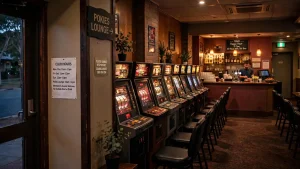
Signage has its own placement rules. A sign directing patrons to a gaming lounge must be removed if it is within eyeshot of an ATM or EFTPOS terminal. A sign directing patrons to an ATM must be removed if it is within eyesight of gaming machines. These are not interchangeable restrictions: the direction of the sign and the nearby facility or machines both matter. A venue’s layout therefore affects what can remain displayed.
When comparing Canberra venues, “best” is not an operational finding. A busy floor, a visible sign or a staff member at reception does not establish whether an RGO is on duty during machine operation, whether incidents are recorded, or whether signage is placed appropriately. Those responsibilities are less visible than décor, but they say more about how the floor is managed. Details matter.
A claim that pokies are available around the clock is stronger than a claim that a venue is open late. It suggests continuous access to the gaming floor, not simply a long trading day or a machine area that operates for part of the venue’s hours. I would not describe any Canberra venue as a confirmed 24-hour pokies venue without current, venue-specific confirmation.
The distinction matters because opening times can apply to different parts of a venue. A bar, restaurant or reception area may have hours that do not match the gaming floor. A venue may also change its schedule, or apply different hours on different days. A broad label such as “open 24 hours” does not, by itself, establish that pokies can be played continuously.
That is where directory listings and old promotional material can mislead. “Always open” sounds definitive, but it may describe a business listing, a service area or an outdated schedule. It is not necessarily a statement about gaming-machine access. From the operational side, those details are kept separate for a reason. A venue’s general trading status is not a substitute for its current pokies hours.
I would treat a round-the-clock claim as unconfirmed unless the venue itself provides a current schedule that clearly covers the gaming floor. The same standard applies to stated opening and closing times: the details should identify the relevant area and the days they cover. If a listing gives only the venue’s general hours, it cannot settle when pokies are available.
That is not a claim that no venue could ever change its hours; it is a limit on what can responsibly be stated as fact. A schedule should be checked with the venue before making plans, particularly where late-night access is the deciding detail.
The practical reading is simple: “24-hour venue” and “24-hour pokies” are not interchangeable descriptions. One can be true while the other is not. Until hours are stated specifically for the gaming floor and kept current, a round-the-clock label remains a claim, not confirmation. Short distinction.
A Crown name beside Canberra can suggest a local venue, a gaming room or a particular set of pokies. Those are separate claims. A name appearing in a title or description does not, by itself, establish that a venue operates in Canberra, that it is affiliated with another business, or that pokies are available there.
That distinction matters because promotional wording can compress several ideas into one label. “Crown” may be used as a brand reference; “Canberra” may identify a location, an audience or simply the subject of a page. The words sitting together do not explain the relationship. I have seen how a confident heading can make an association feel settled before the underlying details have been checked. The wording does the work. The evidence may not.
A useful check is to separate the claim into parts: the exact venue name, its address, the operator responsible for it, and whether gaming machines are actually offered there. Each part needs its own support. A venue name alone cannot confirm the operator; an operator name alone cannot establish a Canberra address; and a general casino reference cannot confirm a local pokies floor.
The same care applies to descriptions of a “pokies room”. That phrase can sound like a named, established facility, but it is not proof of a room’s existence or of what it contains. A page that attaches Crown to Canberra should make the relationship explicit rather than relying on proximity between the words. If it does not, the connection remains an assumption, not a practical detail.
Claims about maximum cash payouts require a different kind of precision. A headline figure, if one is used, needs to identify what it applies to and the conditions behind it. It should not be read as a general promise about every machine, venue or winning session. A number without that context can create an expectation that the actual terms do not support. No shortcut there.
The sensible standard is plain: treat brand, location, affiliation and machine offering as distinct details. A polished label can bring them together; it cannot prove them together. For Canberra, the name alone settles nothing.
A club in Canberra’s central business district may appear in a directory, booking page or local discussion without that establishing whether it has pokies. The name “club” does not confirm a gaming floor, the machines available, or the conditions of access. I would separate those details rather than treat a venue label as proof.
That distinction matters when a list calls something the “best” in the CBD. Without confirmed information about the venue and its machines, a ranking is only a claim. It cannot establish what is offered on the floor, whether a particular machine is operating, or whether the description remains current. A polished listing does not fill those gaps.
For a club-specific check, the useful evidence is direct and current: the venue’s own published information or confirmation from the venue about whether it operates pokies and any relevant access conditions. A third-party page can help identify a place to investigate, but it should not be treated as confirmation of machine availability. Details can change. Check the particular point, not just the venue name.
Self-exclusion is a separate issue from finding a venue. Responsible gambling tools include self-exclusion, alongside deposit, loss and session-time limits. Their existence as tools does not establish how a particular Canberra club administers them. Local arrangements should be confirmed with the venue or the relevant authority, rather than inferred from a general description.
Tools include self-exclusion, deposit limits, loss limits, and session-time limits. Note that BetStop applies specifically to Australian-licensed operators and does not bind offshore sites.
BetStop has a specific boundary: it applies to Australian-licensed operators and does not bind offshore sites. That matters when exclusion is being considered across different forms of gambling. It should not be presented as a universal block on access to every gambling service.
I have seen how a broad label can do too much work: “club” sounds specific, but it does not answer the practical question about pokies. The same is true of a ranking that offers no verifiable basis. Until the venue confirms its facilities and relevant arrangements, the responsible description is simply that those details remain unconfirmed.
No assumed shortlist. No borrowed certainty.
A reference to Parkes is not enough to identify a Canberra venue or establish that pokies are available there. A place name can be detached from its address when listings are copied, shortened or displayed without context. I would treat a result that says only “Parkes” as a lead, not as confirmation of a location or a machine floor.
The useful check is specific: does the venue’s own current information give a street address, and does it state that gaming machines are available at that address? If those details are absent or inconsistent, the claim remains unresolved. A map pin can help identify where a listing points, but it cannot confirm what operates inside the building.
This matters when comparing claims about the best pokies in Canberra. A venue cannot be meaningfully assessed for location or access until the venue itself is identified. Nor does a directory entry, a photograph, or a broad label such as “club” establish that pokies are offered. Those are separate details, and one should not be allowed to stand in for the other.
I have seen how a vague listing can acquire the appearance of certainty simply by being repeated. The wording becomes familiar; the underlying address may still be unclear. That is not a local recommendation. It is an unverified claim.
For anyone weighing information about pokies in Parkes, the practical standard is modest: match the name to a precise address, then confirm the machine offering with the venue directly. If the details cannot be matched, it is better not to treat that listing as evidence of Canberra pokies in Parkes. No ranking follows from a place label alone.
“Cashless” describes how a transaction is made; it does not identify what a machine accepts. A Canberra venue’s use of cashless systems cannot be inferred from the word PayID, and PayID should not be treated as a payment feature of local pokies without venue-specific confirmation.
PayID is an alias service connected to the New Payments Platform (NPP). It lets a transfer be addressed using an email address, mobile number or ABN rather than bank account details. The NPP is available through all major Australian banks and protects transfers with end-to-end encryption. That describes the payment infrastructure, not a gambling product or a guarantee about the recipient.
For online transactions, PayID has a separate role: an account holder must first link it to a bank account. A specialist review reports that some Australian banks, including major banks, may block transfers to gambling merchants they recognise. The same kind of review describes banks and card companies as increasingly restricting payments to known gambling sites. These are changing payment practices, not a dependable promise that a transfer will be accepted.
I have seen payment labels do more persuasive work than the underlying process warrants. “Instant” can describe the transfer rail while saying nothing about whether a merchant accepts the payment, whether a bank allows it, or what happens if a payment is rejected. PayID support does not establish a site’s legitimacy, fairness or transparency about return settings.
The practical distinction is simple: PayID is a way to direct a bank transfer, while cashless pokies refers to a venue or machine payment arrangement. One does not prove the other. A payment method is not a venue feature.
Australian players can legally play on offshore sites that accept them, but no Australian-licensed online casino exists. The law prohibits companies from offering real-money online pokies to Australian residents without a domestic licence, and players have no Australian legal recourse if an offshore casino withholds winnings.
There is no strategy that can predict or control a spin: each one is an independent random event determined by a Random Number Generator. Set deposit, loss and session limits, and use self-exclusion if needed.
Yes, PayID is treated like any other qualifying deposit method at the recommended sites. You need to link PayID to a bank account to use it for real-money play.
It is the turnover multiplier that tells you how much you must bet before bonus winnings can be withdrawn. For example, a $500 bonus with a 40x requirement means $20,000 in bets; if the requirement applies to the deposit plus bonus, a $500 deposit and $500 bonus at 35x means $35,000 in bets.