A practical guide to venue checks, online protections and why pokies outcomes cannot be predicted from return figures.

“Best” sounds like a settled verdict. In practice, it can mean different things: a game someone enjoys, a return figure displayed in promotional material, or a venue that suits a particular visit. Those are not interchangeable measures. A claim that one pokie is best paying in South Australia needs a clear basis; the phrase alone does not tell anyone what was compared or what the result means.
I have seen how a neat label can do more work than the detail behind it. “Best paying” sounds like a promise about what will happen, when a return percentage describes a setting or theoretical measure, not the outcome of a particular spin. It cannot identify a game that will pay out during a visit. The distinction is easy to lose in a headline. It matters at the machine.
There is also a technical wrinkle behind comparisons of the same game. A specialist review reports that some providers allow casinos to select from more than one return-to-player setting for a pokie. That means a title’s return percentage may differ between casinos. A game name, on its own, therefore does not establish which setting applies in a particular place. Nor does a percentage copied from one description necessarily describe the same configuration elsewhere.
Choosing pokies in South Australia means weighing what is known about each operator before deciding where to play. This list provides a concise reference for the 2026 search.
7Bit Casino
7Bit Casino is operated by Dama N.V. and holds a Curacao license.
MrPacho
MrPacho lists a minimum deposit of A$30. Its stated payout times are 30–120 minutes for crypto and 24–72 hours for fiat.
SkyCrown
SkyCrown is licensed by the Tobique Gaming Commission. Its stated payout times are around 10–15 minutes for crypto and 1–5 days for fiat, with a A$30 minimum deposit.
Wild Tokyo
Wild Tokyo holds a Curacao license and has a A$10 minimum deposit. Its stated payout times are 30–60 minutes for crypto and 1–5 days for fiat.
Uptown Pokies
Uptown Pokies has operated since 2017 and holds a Curacao license. Its minimum deposit is A$20.
Thor Casino
Thor Casino is licensed in Curacao by Antillephone N.V. for Versus Odds B.V. Its minimum deposit is EUR 20.
Roby Casino
Roby Casino is licensed by Curacao eGaming, with Roby Games Ltd listed as the operator.
Ricky Casino
Ricky Casino lists crypto payouts in under an hour and PayID payouts in 1–3 business days. The minimum deposit is A$20, or A$30 to qualify for the bonus.
GoldenCrown
GoldenCrown holds a Curacao Gaming Control Board license, OGL/2023/176/0095, with Hollycorn N.V. listed.
LevelUp Casino
LevelUp Casino holds a Curacao eGaming license, OGL/2023/174/0082, and is operated by Dama N.V. Its minimum deposit is A$15.
That is a reason to read the claim carefully, not a method for forecasting results. Each spin is an independent random event determined by a Random Number Generator. A displayed return figure does not tell what the next spin will do, or make one spin more likely to pay because earlier spins did not. Past results do not turn the next outcome into a correction.
The phrase “best pokies in South Australia” can also blur two different questions. A game comparison concerns the game and its settings. A venue comparison concerns a place and the conditions there. A claim about one does not automatically answer the other. Naming a popular title, for instance, would not establish that a particular venue offers it, or that its setting is the same across venues.
The same caution applies to South Australia casino pokies as a broad category. That wording does not identify a single machine, setting or venue. It can refer to very different things, while “best” leaves the basis of comparison unstated. Without that basis, a ranking risks looking precise while mixing unlike measures.
A return figure may be one part of a description, but it is not a complete verdict on what someone will experience. It cannot predict a session’s result, and it does not prove that a game is suitable for a particular person. If the claim does not say which version or setting it refers to, the number can be harder to interpret than the headline suggests.
A list headed “best paying” can create the impression that the games have been tested under identical conditions and ranked by a dependable outcome. The label does not establish that. The same applies to a “best” venue list: a game’s stated return does not rate the venue, and a venue’s reputation does not establish a game’s return setting.
I would separate the claim from the decision it appears to support. Is it describing a specific game, a particular setting, or simply repeating a promotional phrase? Does it say which casino the return figure belongs to? Even when those details are clear, the figure is not a promise about individual results. That is the limit of the comparison.
Searches about pokies in South Australia may combine games, venues and locations in one phrase. Those categories need to be kept apart. A result about a game does not confirm its availability at a South Australian venue; a result about a venue does not establish a particular game’s settings. The word “best” cannot bridge that gap.
The more defensible meaning is modest: a comparison is only as useful as the thing it actually measures. A game title is not a payout forecast. A return percentage is not a guarantee. A venue mention is not evidence that every machine there shares a particular setting. When the wording goes further than those distinctions allow, it is selling certainty the label cannot provide.
That is the working standard I use. Strip away the superlative and inspect the claim underneath. If it describes a game, treat it as a game description; if it gives a return figure, treat that as information about a setting, not the next outcome. “Best” is a headline, not a result.
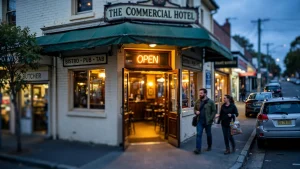
A venue’s listing and its operating status are not the same thing. A map result, directory entry or old social-media post can show that a club or hotel exists without confirming that it is open today. Even a page that appears current may describe ordinary arrangements rather than a temporary change. I treat those details as a lead, not as confirmation.
That distinction matters when someone wants to know whether pokies are available at a particular South Australian venue. “Open” can refer to the building, a dining area, a bar or another part of the business. It does not, by itself, confirm that the gaming area is accessible or that machines are operating at that moment. The general door status and the status of the pokies are separate questions.
I have seen this confusion arise because listings compress a complicated operation into a simple label. A venue may remain open for one purpose while another area is closed, or its arrangements may change without every public listing being updated at once. A search result cannot reliably show which situation applies. Nor does an address or an old customer review establish what is happening now.
The useful check is direct and specific. Contact the venue using a current phone number or contact channel published by the venue itself, then ask whether it is open at the time in question and whether its gaming machines are operating. Asking both parts separately avoids the easy but misleading answer that the venue is “open” when that does not settle the question about pokies. If the answer is unclear, it is still unclear.
A search for South Australia pokies open now expresses an immediate need, but the wording cannot make a listing live. Opening information can be affected by a public holiday, a private event, maintenance, staffing or a change in the venue’s schedule. Those are reasons to confirm, not a basis for guessing. A page that gives a regular schedule may still not account for a change on the day.
The same applies to claims about early or late access. A result that appears to match a preferred time does not prove that the premises, gaming area and machines are all available then. A venue’s own confirmation is the practical way to separate these details. If a call is unanswered, that is not evidence that the venue is closed or open; it simply leaves the status unresolved.
I avoid reading too much into wording such as “open” or “gaming available”. The first may concern the venue generally, while the second may be broad promotional language rather than a live update. A clear answer should identify the relevant area and whether machines are operating, not merely confirm that the business exists. Small distinction. Real consequence.
There is also a difference between machine availability and a particular machine being free to use. A venue might confirm that its gaming area is operating without confirming which machines are accessible or occupied. Such details can change quickly and are not something a static listing can settle. The sensible expectation is limited: a direct response can clarify the venue’s present arrangement, but it is not a promise that conditions will remain unchanged on arrival.
Search results can be useful for locating a venue’s own contact details, but they should not be treated as a live operating record. Information copied between directories may persist after the original page changes. A recent review can also describe one visit, not the venue’s present status. Dates and context matter more than a confident label.
Where the venue provides more than one contact route, use the one that appears to be maintained by the business. If its website and a third-party listing disagree, the disagreement is a reason to confirm directly, not to choose whichever answer is more convenient. For a venue with separate areas, ask about the specific area relevant to pokies. That is more useful than asking only whether the whole venue is open.
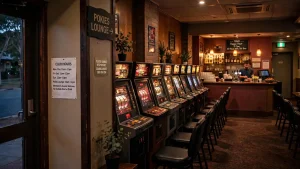
There is a staff requirement worth keeping in context. A report by regionriverina.com.au describes a rule taking effect from 1 July: venues operating more than 20 gaming machines are to have a dedicated Responsible gambling officer (RGO) on duty while those machines are running. That requirement concerns oversight during machine operation; it does not establish a venue’s opening schedule, nor does it mean that machines are operating whenever the premises are open.
For a current decision, the distinction remains straightforward: confirm the venue’s status and ask separately about the gaming machines. Neither an old listing nor the existence of a venue can answer both questions.
A location-based result can make a nearby pokie venue look straightforward to find. It is not the same as confirmation that a particular venue exists at the stated place, that it is close to the intended destination, or that its machines are available. A map pin is a lead, not a guarantee.
Airport searches are especially easy to misread. A result described as being near a South Australian airport may be measured from a broad airport area, a road entrance or a point selected by the listing service. Those are different reference points. The distance shown on a screen does not establish how practical the trip is, and a place labelled “at the airport” need not be inside a terminal or even on airport grounds.
The same care applies to CBD searches. “Central” can refer to a city centre, a suburb, a business district or simply a phrase in a listing. A result near a CBD does not prove that it sits within the district a visitor has in mind. Nor does a CBD label say anything about the number, type or current availability of pokies inside. Location is one question; what is operating at the destination is another.
I have seen how a tidy label does its work. “Nearby” sounds like a measured fact, but the underlying location may be approximate, the reference point may be unclear, or the result may be selected because its wording matches the place name. Useful shorthand. Not a site inspection.
Search wording can also cross regional boundaries. A request that combines South Australia with “Vic” may be mixing state names rather than identifying a precise location. “North South Australia” could mean a broad part of the state, not a particular town or venue. A reference to Parkes may likewise point to a place-name mismatch. None of those combinations, on their own, identifies a verified local destination. The label needs interpreting before it can support a journey.
“Near me” has another limitation: it depends on the location being used by the device or service. If that point is not the traveller’s actual position, the results may be close to the wrong place. Even an accurate position only helps with distance. It cannot confirm that the destination’s details are current or that pokies are operating there.
For a practical check, the useful distinction is between three separate claims: a listing names a place, a map places it in relation to a chosen point, and the venue confirms what is available on site. One does not automatically prove the others. I would treat the first two as navigation clues and the last as the operational detail that matters. No shortcut.
This matters when the destination is an airport, a CBD or a place outside the expected region. A result that appears close on a map can still be irrelevant to the traveller’s route, while a place-name match can draw attention away from the intended state. The search result itself does not settle those questions.
So a South Australian airport or CBD label can help narrow a location, but it cannot establish proximity in the way a traveller means it, or confirm machine availability. A sensible reading separates the map’s suggestion from the venue’s own information. Location wording is not proof.
The phrase “online pokies” can make a real-money service sound like a digital version of a local venue. Legally, they are different. Under the Interactive Gambling Act 2001, companies cannot provide real-money online casino games, including pokies, to people in Australia without a domestic licence. No such licences have been issued, so there is no Australian-licensed online casino.
That distinction matters when a South Australian search brings up offers framed around local play, a first deposit or a “no deposit” bonus. The wording of an advertisement does not create a domestic licence or Australian consumer protection. Nor does a page aimed at people in South Australia change the legal position. The operator’s location and marketing language do not turn an unlicensed online casino into a locally regulated one.
I have seen promotional terms do their work by making the first step sound cost-free. “No deposit” describes an offer, not the protections behind it. A real-money service remains an online casino service, whatever the promotion calls it. The same applies to claims about higher limits or a maximum bet: those labels say nothing about whether an operator can lawfully serve people in Australia or whether winnings can be recovered here.
The practical risk becomes clearest when a withdrawal is disputed. If an offshore casino refuses to pay, Australian players have no legal recourse in Australia to compel payment. That is not a minor gap in customer service. It changes what a player can do when an account is closed, a balance is withheld or terms are interpreted against them. An attractive advertised return or bonus cannot repair that weakness.
The law targets the companies providing the service, not individual players. Australians are not made criminally liable simply for playing on an offshore site that accepts them. That does not mean the service is protected or endorsed. The Interactive Gambling Act is enforced by the Australian Communications and Media Authority, which blocks access to illegal offshore gambling sites; internet service providers must comply with its blocklist. A site appearing online, or being mentioned in a promotion, is not evidence of lawful local operation.
There is also a limit to what familiar safety tools can do. BetStop applies to Australian-licensed operators; it does not bind offshore sites. A person who has self-excluded through BetStop should not assume that the exclusion will prevent access to an offshore casino. The gap is structural: the tool cannot impose its rules on an operator outside the Australian licensing system.
Where an account involves a withdrawal, identity and address documents should be verified before the first withdrawal is attempted. That check is not a substitute for legal protection, and submitting documents does not guarantee payment. It is simply part of establishing what the account requires before money is at stake.
For online real-money pokies, “available” and “protected” are not the same thing. The legal framework leaves no Australian-licensed online casino, and an offshore operator’s promise cannot supply the recourse that is absent. A hard boundary.
A venue’s reputation and its oversight arrangements are different things. A club may appear busy, polished or popular without that revealing how staff respond when gambling begins to cause concern. I have found that the useful distinction is between what a venue looks like from the public area and what its operating procedures require behind the scenes. Neither is a basis for calling it the best pokies venue in South Australia.
One report published by regionriverina.com.au describes a requirement for venues operating more than 20 gaming machines to have a dedicated responsible gambling officer (RGO) present while those machines are running. The report also describes a one-month transition period for venues to remove specified signage and introduce the officer role. This is a reported measure, not proof that any particular South Australian venue meets it. The practical point is that an RGO is tied to machine operation, rather than simply being a name on a staff list.
The role matters because visible distress does not always arrive as a formal complaint. Staff may notice a patron becoming agitated, staying at a machine despite signs of harm, or behaving in a way that raises concern. A procedure has value only if employees know who takes responsibility, what information is recorded and how an incident is followed up. A title alone tells little. The process does.
The same report says venues are to keep a gambling incident register, including records of occasions when a patron’s behaviour suggests they may be at risk of, or affected by, gambling harm. That changes oversight from an informal exchange between staff into a recordable event. A register can help establish what was observed and how the venue responded; it is not, by itself, proof that the response was adequate or that harm was prevented.
There is also a practical distinction between signage that provides information and signage that directs people towards gambling or cash access. Signage directing patrons to gaming lounges must be removed when it is within eyeshot of ATMs or EFTPOS terminals. Signs directing patrons to ATMs must be removed when they are within eyesight of gaming machines. Placement matters. A message that seems harmless in isolation can become part of the environment around a gambling decision.
For someone comparing pokies venues in South Australia, these operational details are more meaningful than a broad label such as “responsible”. The word can sound reassuring while leaving the working arrangements obscure. An officer on duty, a record of incidents and appropriate sign placement are concrete matters to establish for a specific venue; they do not establish its machine quality, nor do they make it a recommendation.
The record is not the response.
“Open around the clock” sounds precise, but it can conceal two different claims: that a venue admits patrons at any hour, and that its pokies are available throughout that period. Neither follows automatically from the other. A venue might describe its broader operations while gaming areas have separate access arrangements; the wording alone does not establish what is happening on the floor.
I have seen how a short label can do too much work. “24-hour pokies” may be read as a promise of uninterrupted machine access, even when the information behind the label is less specific. It could refer to the venue, a service desk, or a listing that has not been checked recently. The distinction matters. A door being open is not the same as pokies being in operation.
That is why a round-the-clock claim should be checked directly with the venue and framed narrowly. The useful point to confirm is whether pokies are operating continuously, not merely whether the building or another part of the business remains accessible. A general opening-hours listing cannot settle that question unless it clearly addresses gaming-machine operations as well.
“Open now” is also a moment-specific claim. A result displayed earlier may not reflect a later change, and a venue’s regular schedule does not, by itself, confirm that its pokies are operating at the time of arrival. Search wording can make those separate details look like one answer. They are not.
South Australia’s general pokies opening hours cannot be inferred from a phrase such as “24-hour venue”. Nor does that phrase establish that any particular venue in the state provides continuous machine access. Without a current, venue-specific confirmation, the claim should be treated as unconfirmed rather than as a statewide rule.
In practice, I would separate the checks: first, whether the venue is accessible at the intended time; then, whether its pokies are operating during that same period. If staff confirm only the first point, the second remains unanswered. That is not pedantry. It is the difference between a building’s schedule and the availability being sought.
A round-the-clock label is not a timetable. Verify the precise claim locally.
A search combining Crown with South Australia can join a venue name and a state without establishing that the venue, a particular pokies room or any machines are located there. The wording expresses an association, not proof of one. I have seen how easily a result can look definitive when its title repeats the terms being searched; that does not make the location connection reliable.
The distinction matters because “Crown” may be used as a reference point in a search, while “South Australia” identifies the area of interest. Neither term confirms the other. A result mentioning both may discuss a comparison, an event, a travel route or another context entirely. The name by itself cannot verify a South Australian venue or the availability of pokies at one.
The same care applies to phrases about pokies at a Crown casino in South Australia. They imply a specific venue relationship, but the wording alone cannot establish that relationship. Nor does a page that mentions Crown necessarily describe a room with machines, its facilities or its current offerings. Search results are leads, not a venue register. That is the practical limit.
“Best pokies room” is another phrase that sounds like a ranking but leaves the basis unclear. Best for what: the layout, the range of machines, access or something else? Without comparable venue-level information, the label cannot support a meaningful South Australian ranking. An advertising description may be designed to attract attention; it is not a measured comparison.
Cash payout claims need the same separation between a broad search and a specific rule. A maximum payout is not something that can be inferred from a venue name or from the state in a search phrase. Any applicable amount and conditions would need to be established from the relevant venue’s current information. A headline cannot settle it.
I would treat Crown-related wording as a prompt to check what a result actually refers to: the location, the organisation or venue named, and whether the page describes pokies in South Australia at all. Those are separate details, not interchangeable labels. If the connection is not explicit, it should not be assumed.
No shortcut.
A search for club pokies in the South Australian CBD can point towards a venue, but it says nothing about the controls available once someone is there. I learned to separate the attraction of a gaming room from the practical question of how play can be kept within bounds. “Best” is a sales word; limits are the working detail.
Responsible-gambling tools include deposit limits, loss limits and session time limits, as well as self-exclusion. Each addresses a different point at which play can be interrupted: money going in, losses accumulating, time passing, or access being stopped altogether. They are not interchangeable. A time limit does not set a spending boundary, and a deposit limit does not by itself account for money already available to play.
For someone looking into self-exclusion from pokies in South Australia, the useful distinction is between a tool’s name and its actual scope. The arrangements that apply to a particular club or group of venues need to be checked with the relevant operator. A general mention of self-exclusion does not establish which places it covers, how it is activated, or what steps are involved. Those details matter more than a broad claim that a venue takes responsible gambling seriously.
BetStop is a separate service, not a universal block on gambling. It applies only to Australian-licensed operators and does not bind offshore sites. That limitation is important when people treat a single exclusion measure as if it covered every form of gambling. It does not.
In my experience, the most useful controls are the ones that create a clear stopping point before the session begins, rather than relying on a decision made during play. That is a practical distinction, not a promise that any tool will prevent harm. A limit can define a boundary; it cannot make a game predictable or guarantee that someone will keep to the boundary.
CBD location and club branding do not change the purpose of these tools. They are safeguards for managing activity, not evidence that a venue’s machines are suitable for a particular person. Check the scope and operation of any control directly with the organisation responsible for it. Fine print matters.
“Cashless” can describe different things: paying for something at a physical venue without notes, or transferring money through an online payment system. Those are not interchangeable claims. A mention of cashless pokies in South Australia does not, by itself, establish what payment facilities a particular venue has or whether its machines are operating.
PayID belongs to the second category. It is an alias service layered over Australia’s New Payments Platform (NPP): a transfer can be directed using an email address, mobile number or ABN instead of entering bank account details. The NPP is available through all major banks and protects transfers with end-to-end encryption. That describes the payment infrastructure, not the business receiving a transfer.
I have seen payment badges used as shorthand for trust. They prove less than the presentation suggests. A PayID option does not establish that an operator is licensed, that a game is fair, or that its return settings are disclosed. Payment support is a transaction feature; it is not a regulatory credential.
The same distinction matters when a cashless payment method is discussed alongside online pokies. A familiar Australian transfer mechanism does not change the legal status of the service receiving funds. The rails and the operator are separate questions.
“Best pokies in Newcastle, South Australia” also combines a venue-location question with a payment question, but that wording alone cannot confirm a South Australian venue, its machines, or its cashless arrangements. Newcastle is commonly associated with New South Wales, so the location needs to be resolved before any venue detail can be attached to it. A payment method cannot settle that ambiguity.
The useful distinction is narrow: PayID explains how a bank transfer may be addressed. It does not tell what is available at a venue, or certify the recipient. Separate questions.
A pokie’s result is determined spin by spin. Each spin is an independent random event produced by a Random Number Generator (RNG). In practical terms, a run of wins does not make a loss “due”, and a string of losses does not mean a win is now more likely. The previous result does not set the next one.
That distinction is easy to lose when a machine has a memorable theme, a feature round or a prominent prize display. Those details shape the experience; they do not turn an individual outcome into a forecast. “Hot” and “due” are familiar floor talk, but neither describes how the next spin is determined. I have heard both used to explain patterns after the event. They are stories, not evidence of what comes next.
This matters when comparing pokies in South Australia. A game’s popularity or a venue’s reputation cannot establish what will happen on a particular spin. Nor does a result at one machine provide a reliable guide to another. Claims about a particular South Australian game or venue need evidence specific to that claim; a general fact about random outcomes cannot supply it.
The phrase “best pokies” can sound like a promise of better results. It is not a dependable description of what an individual spin will deliver. A machine may produce a win, a feature or no return on a given play, but randomness offers no guarantee and does not follow a player’s expectations.
The useful distinction is plain: a game can be described by its design, while its next result cannot be known in advance. That is the limit of prediction. No guaranteed return.
You must be at least 18 years old to gamble online in Australia.
Real-money online pokies are not legally offered to Australian residents by any Australian-licensed online casino. The law targets operators rather than players, and Australians can play on offshore sites that accept them, but they have no legal recourse in Australia if one refuses to pay winnings.
Yes, PayID is treated like any other qualifying deposit method at the sites described.