The wording links a payment method with online casino searches, but does not establish that a service is available or accepts it.
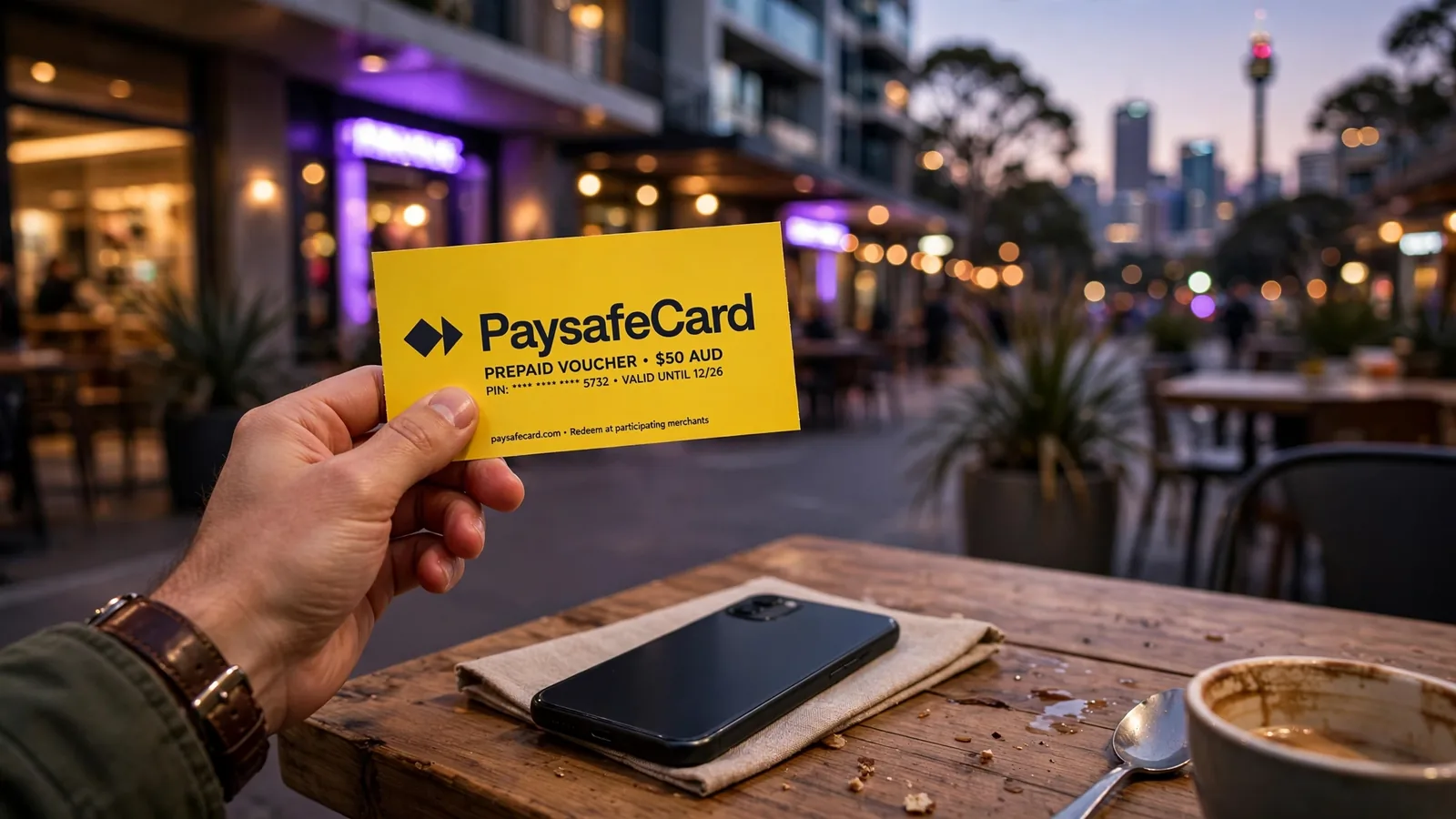
When I see Australian pokies wording paired with Paysafecard, I read it first as a compatibility question. The person is trying to connect a familiar payment name with a category of online gambling, often with Australia added to narrow the results. That wording signals an expectation of a straightforward match: a service described as Australian, a way to pay, and a place to play. It does not, by itself, establish that such a service is available or that the payment method is accepted.
The wording varies, but the underlying uncertainty is much the same. “Pokies” may be used where another person would write “online casino”; “Australian” may refer to the person searching, the intended audience, or a site’s marketing language. “Paysafecard” supplies the practical filter. Put together, the terms look like a request for a usable combination, not an abstract explanation of payment systems.
That distinction matters. Search language is compressed: it leaves out the conditions that would make a payment claim meaningful. A phrase such as “accepts Paysafecard” can sound definitive while saying nothing about who may use the service, where it operates, what its terms allow, or whether the service is lawful for its intended audience. The brand name in a page title is not proof of compatibility. Neither is a broad description of a site as Australian.
Paysafecard availability can vary by casino and location, so check the payment options shown to you before depositing. This list offers a concise reference to the available operator details relevant to your search.
7Bit Casino
7Bit Casino is operated by Dama N.V. and holds a Curacao license.
MrPacho
MrPacho lists a minimum deposit of A$30. Its stated payout times are 30–120 minutes for crypto and 24–72 hours for fiat.
SkyCrown
SkyCrown is licensed by the Tobique Gaming Commission. Its stated payout times are around 10–15 minutes for crypto and 1–5 days for fiat, with a minimum deposit of A$30.
Wild Tokyo
Wild Tokyo holds a Curacao license and has a minimum deposit of A$10. Its stated payout times are 30–60 minutes for crypto and 1–5 days for fiat.
Uptown Pokies
Uptown Pokies has operated since 2017 and holds a Curacao license. Its minimum deposit is A$20.
Thor Casino
Thor Casino is licensed in Curacao by Antillephone N.V. for Versus Odds B.V. Its minimum deposit is EUR 20.
Roby Casino
Roby Casino is licensed by Curacao eGaming, with Roby Games Ltd identified as the operator.
Ricky Casino
Ricky Casino states that crypto payouts take under an hour and PayID payouts take 1–3 business days. Its minimum deposit is A$20, or A$30 to qualify for the bonus.
GoldenCrown
GoldenCrown holds a Curacao Gaming Control Board license, number OGL/2023/176/0095, and is associated with Hollycorn N.V.
LevelUp Casino
LevelUp Casino holds a Curacao eGaming license, number OGL/2023/174/0082, and is operated by Dama N.V. Its minimum deposit is A$15.
I learned to treat payment labels as the start of a check, not its result. In commercial copy, “supports” or “accepts” can be made to carry more weight than the underlying detail warrants. The label may describe an option shown in a cashier, a condition that applies only to some account holders, or a claim that has changed since it was written. Without the surrounding terms, the word leaves too much unresolved.
The mobile phrasing adds another layer, but not necessarily a new payment question. It may mean that the searcher wants to use a phone, or simply that mobile access is part of the idea of an online service. It does not establish that a payment method works on every device or that a gambling service is available through a mobile browser or application. Those are separate questions, even if the search terms compress them into one.
Likewise, adding “best” or “new” expresses a wish to narrow options, not evidence that a ranking exists or that a recently described service is suitable. I would not treat those labels as a quality measure. In gambling marketing, a tidy adjective can substitute for the details that actually determine whether a claim applies. A polished heading is not a payment confirmation.
The Australian qualifier also needs careful reading. A site can use Australian-facing language without being an Australian service, and the word “Australian” in a search does not settle where an operator is based or what rules apply. This is not a technicality. The Interactive Gambling Act 2001 prohibits operators from providing real-money online casino games to people in Australia. The Australian Communications and Media Authority enforces that law. Australian consumer law does not protect people who use offshore casinos.
That context changes how the payment wording should be understood. A search for an Australian online casino that accepts Paysafecard cannot be treated as a neutral shopping request for a service that is necessarily available to Australians. The payment question sits inside a market where operators are prohibited from supplying real-money casino games to people located in Australia. A payment label does not alter that position.
I have seen how easily separate ideas get collapsed into one phrase: Australian audience, online pokies, and a named payment method. Yet each part carries a different implication. The country term describes the intended market in the searcher’s mind; the game term identifies a prohibited online casino category under Australian law; the payment name indicates a hoped-for way to transact. None cancels the others out.
So the broad intent is understandable: the searcher wants to know whether Paysafecard and an online-pokies service fit together in an Australian context. But the phrasing alone cannot verify acceptance, availability, or lawful provision. Nor does it transform a marketing description into a reliable account of what can be used. The practical answer begins by separating those claims, rather than assuming that one familiar payment name settles them.
That is the useful distinction. Compatibility is a question; a search phrase is not its answer.
A deposit-focused search is asking a narrower question than whether a payment brand is associated with a casino. It concerns the point at which funds would be added to an account: whether Paysafecard is shown as an option, whether a particular payment can be completed, and what conditions apply before an account balance changes. Those are separate checks. A method appearing in general payment information does not establish that it is available in a cashier or that a transaction will be accepted.
I have seen payment wording do a lot of quiet work in this industry. “Accepted” can sound like a simple yes-or-no statement, but it may refer only to a method being listed, not to every customer, account or transaction. Availability can depend on the operator’s own payment rules and the circumstances of the transaction. Without current, specific terms, a general statement about Paysafecard cannot confirm what would happen in a particular cashier.
The same distinction matters when a search names a small fixed deposit. That wording expresses an amount someone hopes to fund an account with; it does not show that a site accepts that amount, supports Paysafecard, or permits the two conditions together. A minimum deposit and a payment method are independent details. Both would need to be stated in the applicable terms and reflected in the cashier. Combining them in one phrase does not make either one verified.
That is the difference between a payment label and a usable payment route. A cashier is where an account’s available funding methods and transaction conditions would be presented. A name mentioned elsewhere may be general information, outdated material, or a description that does not apply to Australian users. The important question is not whether Paysafecard is discussed at all, but whether the relevant terms actually describe an available deposit option for the account and location in question.
There is also a legal boundary that changes how this subject should be presented in Australia. The Interactive Gambling Act 2001 prohibits operators from providing real-money online casino games to people physically located in Australia. A discussion of deposit wording must not turn into a recommendation or an invitation to fund an account. Australian consumer law does not protect players who use offshore casinos. That is not a minor qualification to payment information; it changes the risk attached to acting on it.
In commercial copy, “easy deposit” often compresses several separate steps into one reassuring phrase. It may leave out account eligibility, cashier availability, payment approval and the operator’s terms. I would not treat such a phrase as evidence that a Paysafecard deposit can be made. Nor does a list of payment brands establish that each one is available for each customer. The wording needs to be read for its exact scope, not its promotional tone.
A useful way to parse deposit claims is to separate three questions. Is the method described? Is it available for the account and location at issue? Do the stated conditions cover the intended transaction? A response to the first question alone is not a response to the other two. Even a page that uses the words “Paysafecard deposits” may be describing a general category rather than confirming a current, usable option.
This is why searches for casinos that accept Paysafecard deposits should not be read as proof that a suitable option exists. They reveal an interest in funding conditions, not a verified list. In Australia, that distinction is particularly important because presenting offshore casino payment routes as actionable would amount to promoting services operators are prohibited from offering to people here. The payment question cannot be separated from that context.
The careful interpretation is therefore limited: deposit-focused wording asks whether a payment method and deposit condition match, but the wording itself confirms neither. A stated amount does not establish a minimum, and a payment name does not establish availability. A promotional label may sound definitive. The terms are what matter—and the Australian legal position remains decisive.
A payment route into an account and a route back out are separate arrangements. That distinction gets blurred when “instant” is attached to both a Paysafecard deposit and a casino withdrawal. The word describes an expectation, not proof that the same method can be used in both directions—or that a payout will be immediate.
I have seen cashier menus treated as if they were a single, two-way connection. They are not. A method appearing among deposit options only shows that the operator presents it for funding an account. Withdrawal options may be handled separately, with their own eligibility rules and processing steps. A deposit label cannot establish what happens when a balance is paid out.
That is why searches combining Paysafecard with instant pokies withdrawals do not settle the practical question. They express a wish for a fast payout associated with that payment method; they do not confirm that a particular service supports Paysafecard withdrawals, or set a timeframe. Nor does a “no deposit” phrase establish a payout entitlement. It is promotional wording, not a payment term. The operative details are the cashier’s withdrawal rules and the account conditions attached to them.
There is another boundary: an account balance is not necessarily ready for withdrawal merely because money was deposited. Online casinos generally require customers to complete identity checks before carrying out financial transactions. In practice, that means verification can be part of the payment process, rather than an afterthought that begins only when a withdrawal is requested. The payment method alone says nothing about whether those checks are complete.
A withdrawal route can also depend on account-specific conditions. The cashier’s displayed methods, the operator’s terms and the status of the account are separate pieces of information. If a method is listed for deposits but absent from withdrawals, that difference matters. If the rules say another route applies, the deposit method does not override them. “Instant” cannot bridge a mismatch between the two.
I would read claims about instant Paysafecard payouts with particular care because the phrase compresses several questions into one: whether the method is accepted for deposits, whether it is available for withdrawals, whether an account has met the relevant checks, and how long the operator takes to process a request. Treating those as one promise is how a headline can sound clearer than the underlying terms.
The Australian context matters too. The Interactive Gambling Act 2001 prohibits operators from providing real-money online casino games to people physically in Australia. Australian consumer law does not protect players who use offshore casinos. That is not a minor qualification to a payment claim; it changes the setting in which any such claim is made. A payment label should not be mistaken for evidence that an online casino service is lawful to provide in Australia or that consumer protections apply.
For a person trying to understand the word “withdrawal,” the useful distinction is plain: deposit compatibility and payout compatibility are different claims. A cashier may show one without establishing the other. A search result may combine “Paysafecard,” “pokies” and “instant,” but those words do not verify a supported payout method, guarantee a processing speed, or remove account checks.
The cleanest reading is the least dramatic one. An incoming payment option is evidence only about incoming payments. A withdrawal statement needs to stand on its own, and “instant” needs specific terms behind it. Otherwise, it is just an adjective.
A payment method can make a website appear locally usable without changing the legal position of its service. In Australia, the relevant distinction is between the way a site handles money and whether it may offer online casino gambling to people in the country. Those are separate questions. A Paysafecard option, if displayed, does not establish that the casino service is lawful for Australian customers.
The Interactive Gambling Act 2001 places the restriction on operators: they must not provide online casino games to people in Australia. That covers real-money casino-style services, rather than making the payment method the deciding factor. The Act does not explicitly make it a crime for an individual to use an offshore casino site. The distinction matters. A restriction aimed at the provider is not the same as a criminal offence imposed on the customer.
I have seen how easily a cashier detail can dominate a decision. A visible deposit option feels concrete: it is a feature that can be checked on a page. Legal status is less visible and cannot be inferred from that feature. “Accepts Paysafecard” describes a claimed payment capability; it does not mean an operator is authorised to offer casino games to Australians, nor does it create local approval where none exists.
The Australian Communications and Media Authority (ACMA) is responsible for enforcing the Interactive Gambling Act. That places the regulator in the enforcement role; it does not turn a payment listing, search result or operator statement into evidence of compliance. The relevant issue remains the service being offered to people in Australia, not simply whether a particular payment brand appears in a cashier.
There is also a practical consequence often obscured by the focus on payment compatibility: Australian consumer law does not protect players who use offshore casinos. That absence of protection is not a minor technicality. If a dispute concerns an offshore service, a familiar-looking payment route does not make the operator a local business or bring the transaction within the safeguards available for domestic consumer services. The cashier cannot supply that protection. It is a payment screen, not a legal status check.
For that reason, descriptions such as “Australian casino” or “available in Australia” need careful reading. They may refer to a site being reachable or to its marketing toward Australian users; neither description overrides the statutory restriction on operators providing online casino games in the country. Likewise, a general claim that a site accepts a prepaid method says nothing by itself about whether the underlying gambling service may lawfully be offered to Australians.
The search for a casino site that takes Paysafecard can therefore produce a misleadingly narrow answer if it is treated only as a compatibility exercise. Payment acceptance and legal permission are not interchangeable. One concerns a transaction feature; the other concerns the operator’s conduct under Australian law. That distinction holds regardless of how a site describes itself or how prominently it displays a payment method.
The plain reading is the useful one: the Act restricts operators, ACMA enforces it, and the Act does not explicitly criminalise players for using offshore sites. But the lack of player criminalisation is not an endorsement, a guarantee of access, or consumer protection. Different questions. Different consequences.
When people combine Paysafecard with casino or pokies terms, the wording can sound like a request for a shortlist. In practice, I read it more cautiously: the person is trying to work out whether a named payment method fits a particular kind of online service. Adding “best” or “website” does not establish that any operator accepts it, or that a comparison can be made on verified terms.
The same applies when the wording shifts towards games. A reference to casino games alongside Paysafecard may express a wish to use one payment option in that setting; it does not show that the payment method is available for every game, or even that a particular site supports it. Payment compatibility is a separate condition from the games a service describes. Search wording joins them together; it does not prove the connection.
“Bonus” language adds another layer of uncertainty. A phrase linking Paysafecard and bonuses may reflect an expectation that a payment method changes eligibility for an offer. It cannot, by itself, confirm that an offer exists, that it applies to a particular payment method, or that the service may lawfully promote it in Australia. Promotional wording tends to make separate conditions look like one package. They are not.
I have seen how a tidy label can conceal several unresolved checks. A cashier may list a method, while the operator’s terms set separate conditions; the payment provider or a bank may also affect whether a transaction proceeds. The broad label does not disclose those details. Nor does it say whether a reference is current or whether it applies to Australian residents. The words are not a cashier.
There is also a more basic Australian constraint behind the phrasing. The Interactive Gambling Act 2001 bars operators from providing real-money online casino services to people in Australia, including casino-style games. A search result using familiar payment language does not alter that position. Australian consumer law does not protect players who use offshore casinos. That is not a minor qualification to an otherwise ordinary shopping choice.
So the useful interpretation is narrow: the wording expresses interest in payment compatibility, perhaps combined with curiosity about games or promotions. It does not establish an available or lawful service, a verified list of operators, or the terms of any offer. I would separate those ideas rather than treating a polished page title as evidence that they have all been checked.
A “best” label is especially easy to mistake for a finding. It may simply be a ranking claim, and a ranking does not settle whether the underlying service is permitted to offer casino games to Australian residents. Likewise, a page describing a payment option cannot turn that description into proof of current acceptance or protection for a player. The distinction matters. Search phrasing can point to an intention; it cannot supply the missing conditions or make a prohibited service lawful.
When a payment method and a game category appear together, the wording can blur two separate questions. “Paysafecard for casino games” may sound as though the method belongs to particular games. In practice, a payment method concerns how an account is funded; a game’s availability is a separate matter. One does not establish the other.
I have seen this distinction get lost in cashier language. A cashier presents payment options at account level, while a game catalogue groups titles by type. Putting the terms side by side in a menu or page heading does not show that a payment method is tied to a particular title, or that it is available for every title on a service. Labels are not the same as transaction conditions.
The same applies to phrases about “Paysafecard slots” or casino games “using” Paysafecard. They can describe an intended way to pay for access, but they do not mean that a game itself processes a payment. Nor do they establish that a particular game or payment option is available in Australia. Those are separate operational and legal questions.
That distinction matters particularly in Australia. The Interactive Gambling Act 2001 makes it illegal for operators to provide real-money online casino games to people physically located in the country. The prohibition includes online slots and other casino-style games. A payment reference cannot change the status of the service being paid for. Australian consumer law also does not protect players using offshore casinos. Plainly stated.
So the useful reading of a games-and-payment phrase is narrow: it signals interest in whether a payment method is connected with an online casino service, not proof that the method works with a named game. A cashier’s displayed options, the operator’s terms and the legal status of the service are distinct parts of the picture. Combining them in a single search phrase does not combine their conditions.
I treat game labels and payment labels as separate entries in the same system. One describes what the service offers; the other describes a possible way to move funds. Neither should be read as a promise about the other. That is the practical limit of the phrase “casino games with Paysafecard”: it expresses a payment-related interest, not a verified game feature or an assurance of lawful availability in Australia.
When Paysafecard appears alongside pokies and withdrawals, the wording points to a payout question, not simply whether the payment method is mentioned somewhere on a casino page. I have seen how easily those two things get blurred in payment copy: a method shown near an account’s funding options can look like an all-purpose route, even when the text has not established that.
A withdrawal is a separate transaction with its own conditions, involving the request method, the destination for funds, and the processing timeframe.
A withdrawal is a separate transaction with its own conditions. The presence of Paysafecard in a payment description, or a reference to using it with pokies, does not by itself show that winnings can be sent back through it. Nor does a page labelled “all Paysafecard casinos” establish that every listed payment function is available. The label is broad; the terms need to be specific.
That distinction matters because “withdrawal” is often used as shorthand for several different things: the method used to request a payout, the destination that can receive funds, and the time before the funds become accessible. Those are not interchangeable. Without clear terms that identify Paysafecard as a permitted withdrawal destination, its role in a payout remains unconfirmed. No inference from a deposit option fills that gap.
There is also an Australian context that payment wording cannot resolve. Under the Interactive Gambling Act 2001, operators may not provide real-money online casino games, including pokies, to people in Australia. The Australian Communications and Media Authority enforces the Act. Australian consumer law does not protect players using offshore casinos. Payment compatibility does not change those conditions or turn an offshore service into a locally authorised one.
In practice, I treat a Paysafecard-and-withdrawal claim as a request to distinguish the transaction route, not as evidence that a payout route exists. A useful explanation should say what the payment method is stated to do and avoid implying more. If the wording only identifies Paysafecard in connection with casino play, the withdrawal question is still open.
The distinction is plain. Method named; payout unproven.
“Paysafecard casino” sounds like a complete description, but it combines two separate ideas: a payment brand and a service category. The wording alone does not establish that any particular site accepts Paysafecard, that the option is available to someone in Australia, or what conditions would apply. It is a label, not evidence of a working payment route.
I have seen how easily a cashier’s list can be mistaken for a full account of what a service permits. A payment method appearing in a general description does not settle whether it is available in a particular location or for a particular transaction. Nor does a site’s use of the word “accepted” explain the limits of that acceptance. The missing detail matters. Broad wording can make distinct arrangements look interchangeable.
That is why “casino sites accepting Paysafecard in Australia” remains ambiguous even when the location is included. “Australia” may describe the person searching, the site’s intended audience, or simply the subject of the page. It does not prove that a service is lawful to offer to people physically in Australia. Under the Interactive Gambling Act 2001, operators cannot provide real-money online casino games to people in the country. The Australian Communications and Media Authority enforces the Act.
There is a further practical distinction between a payment label and a consumer safeguard. Australian consumer law does not protect players using offshore casinos. A page that presents payment compatibility as if it settled the wider question leaves out an important part of the picture. No reassurance in a cashier or promotional description changes that.
I treat the broad phrase as incomplete, not as a recommendation or a verified directory. It can signal interest in whether a payment method and a service are connected, but it cannot establish the operator’s status, the terms of a transaction, or the protections available. Those are separate matters. The wording does not fill them in.
No, a payment option does not establish that the casino service is lawful for Australian customers or that it complies with the Interactive Gambling Act 2001.
No, Australian consumer law does not protect players who use offshore casinos.
No, a method listed for deposits does not prove that the same method can be used for payouts or that a withdrawal route exists.
Adding “Australian” to a Paysafecard casino phrase can mean several different things: a service intended for people in Australia, a payment option available in Australian dollars, or simply a site that mentions Australia. Those meanings are not interchangeable. A geographic label does not establish that a payment method is supported, that an account can be opened from Australia, or that the service is lawful here.
I have seen payment language treated as if it settled the whole question. It does not. A cashier may display a method without confirming that it works for every customer or every transaction. Likewise, the word “Australian” may describe an audience in promotional copy rather than a locally authorised service. The label is not a guarantee.
There is a more fundamental boundary. Under the Interactive Gambling Act 2001, operators cannot provide real-money online casino games to people physically in Australia. That applies to casino-style services regardless of whether their payment pages mention Paysafecard, cards, or another method. The Australian Communications and Media Authority enforces the Act. Payment compatibility does not change that status.
The distinction matters because an offshore service’s claims and an Australian consumer’s protections are not the same thing. Australian consumer law does not protect players who use offshore casinos. A payment brand on a page does not bring an offshore operator within Australian consumer protections, nor does it establish a route for resolving a dispute locally.
My practical reading of the Australian wording is therefore narrow: it signals an interest in geographic availability, but cannot prove availability or suitability. The payment name answers only one part of a much wider question, and even that answer depends on the specific service’s terms and the transaction involved. No more than that.
The country label can look precise while leaving the decisive details unresolved. In this market, it must also be read against the prohibition on operators supplying online casino games to Australian residents. A familiar payment logo does not make the underlying service permissible, locally protected, or accessible. A label is not a safeguard.
 Payments and Crypto Options for Australian CasinosExplore Australian casino payment options spanning cards, bank services, e-wallets and cryptocurrencies, with individual methods covered across the page.
 Casinos that accept PayPal in Australia: what to knowLearn what PayPal availability can—and cannot—show about offshore casinos, including the Interactive Gambling Act 2001 boundary for real-money games in Australia.
 Casinos That Accept Visa in AustraliaLearn why everyday Visa acceptance does not confirm an online casino’s deposit options, and how deposits, withdrawals and legal limits differ.
“Pay with Paysafecard” expresses a preference for a payment method. It does not establish that any particular service accepts it, that it can be used for every kind of transaction, or that its terms suit a particular account. The wording identifies an intended payment route, not a verified arrangement.
That distinction matters because payment language can collapse several separate questions into one. A method might appear in a general description without being available in a specific cashier; an option might be subject to conditions that the short phrase does not reveal. The phrase alone says nothing reliable about eligibility, charges, transaction limits, or how a payment would be handled. Those details cannot be inferred from the method’s name.
I have seen how a cashier turns broad payment wording into a specific choice: the relevant details are the options actually presented and the conditions attached to them. A search phrase cannot substitute for that information. Nor does it show that a payment would be accepted by the payment provider or the user’s bank.
The wording may also join a payment method to casino games or pokies. That pairing still describes an intended combination, not evidence that a game or service is available for real-money play in Australia. The Interactive Gambling Act 2001 prohibits operators from providing real-money online casino games to people in Australia. Australian consumer law does not protect people who use offshore casinos.
So the phrase “casino sites that accept Paysafecard” should not be read as confirmation that such a service can lawfully be offered to Australian residents, or that payment compatibility makes it safe or accessible. A payment label is not a licence, a consumer safeguard, or proof of a working route. Different questions entirely.
Jackpot City Casino, Spin Palace, Ruby Fortune, Ignition Casino, Joe Fortune and PlayAmo are listed as supporting Amex deposits for Australian players. However, Australian law prohibits operators from offering online casino games to Australian residents.
Check the site’s cashier for American Express, then select it and enter the card details and deposit amount in AUD. A listed option does not guarantee a transaction will go through, as the casino or card issuer may block it.
Look for American Express in the casino’s cashier and payment rules. Even if it is listed, the casino or your Australian bank may block a gambling transaction.
Each casino sets its own Amex deposit and withdrawal limits, which can vary. Amex limits are usually higher than those for Visa or Mastercard, but check the casino’s cashier for its current limits.
Some casinos do not allow withdrawals to Amex, and a withdrawal generally requires that you previously deposited with Amex. Where available, a withdrawal can take up to five days to clear.
Amex may block payments to a particular website, and Australian banks may block gambling-related Amex transactions. Acceptance can therefore differ between casinos and card issuers.