The guide separates exchange funding from casino deposits and explains what a SOL transfer does—and does not—establish.
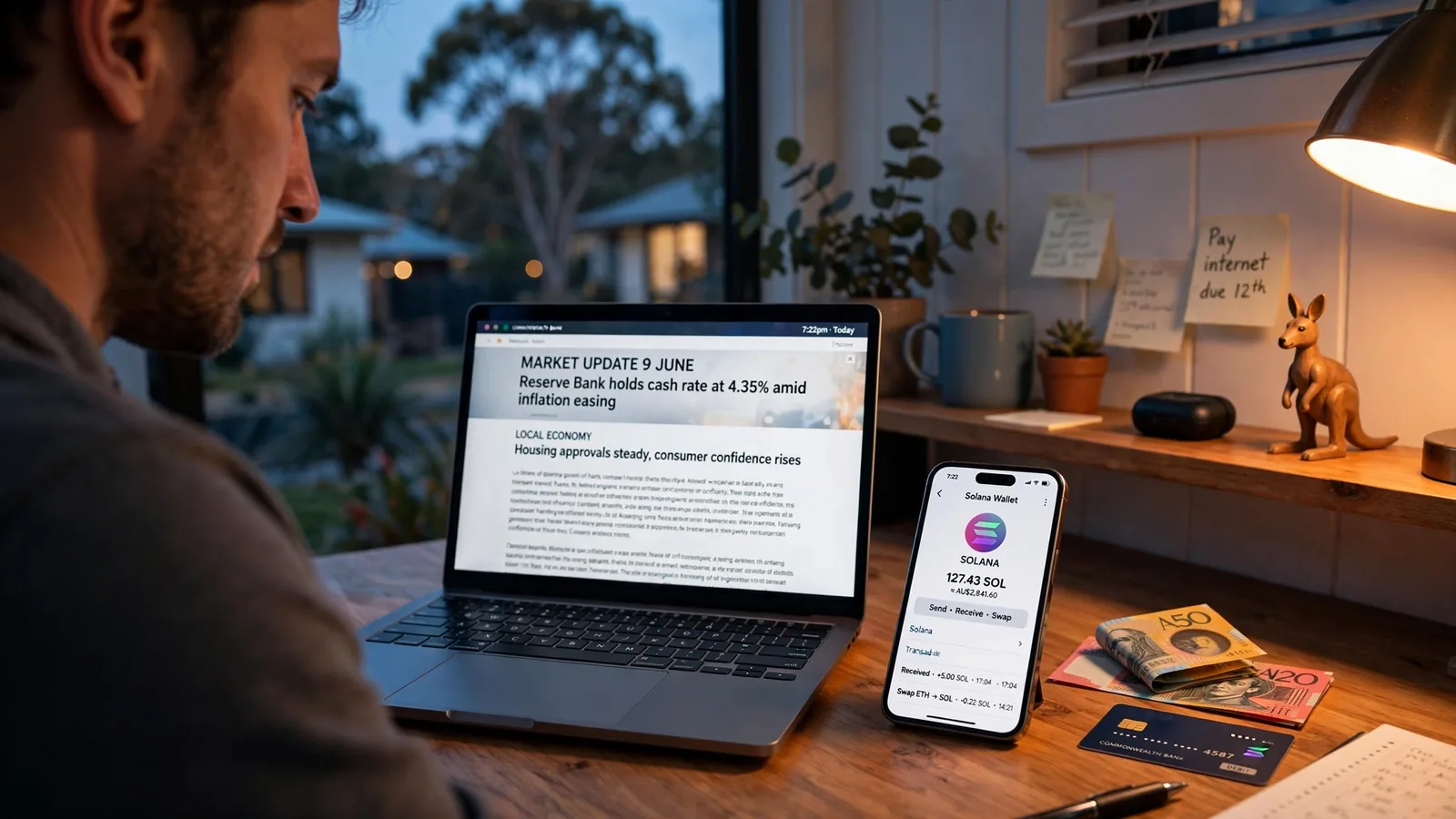
The route from Australian dollars to a balance denominated in SOL is generally an exchange transfer, not a direct casino deposit. Most Solana casinos do not take AUD through a bank transfer or card payment. Instead, AUD is deposited with an Australian crypto exchange, converted to SOL, then sent to a wallet address supplied by the offshore platform.
That distinction matters. A bank deposit to an exchange and a crypto transfer to a casino are separate transactions, handled by different services. I have seen confusion arise when people assume that entering bank details on a casino payment page will fund a SOL balance. In most cases, the casino expects SOL already held in a crypto wallet.
Australian exchanges including Swyftx, CoinSpot and Coinbase AU support AUD deposits through PayID or bank transfer. The exchange account is where the fiat step takes place: AUD arrives there, and an order converts some of that balance into SOL. The amount of SOL received depends on the exchange’s displayed conversion price at the time of purchase.
An exchange will require account setup and may ask for identity information before allowing deposits or trades. On-ramp services that convert AUD to SOL are subject to KYC and anti-money-laundering requirements. Those checks belong to the exchange, not the casino. Passing one service’s checks does not mean another service will treat the account as verified.
After the purchase, SOL can be held on the exchange or moved to a wallet controlled by the account holder. The deposit instructions on the casino platform should specify which wallet address and network are expected. The key operational detail is to use the Solana network for a SOL transfer. A copied address should be checked against the destination shown by the platform before the transfer is confirmed.
A transfer to the wrong address can mean permanent loss: SOL transactions cannot be reversed by asking the sender’s bank to recall them. I treat the address as payment instructions, not as a casual form field. A mismatch between the selected network, the asset and the address can leave funds unavailable, even where the transfer itself has gone through.
Once the exchange has enabled withdrawals, the casino’s deposit page generally provides an address for incoming SOL. The account holder enters that address in the exchange withdrawal form, selects SOL, reviews the transaction details and submits it. The casino balance is credited only after the platform recognises the incoming transfer under its own deposit process.
The network transfer and the platform credit are not the same event. A visible transaction in a wallet or exchange history does not, by itself, prove that a casino account has been credited. If a balance does not update, the transaction record and the deposit instructions are the relevant details for support. Repeating the transfer before checking can create a second payment rather than resolve the first.
Minimum deposits are set by the platform, not by the Australian exchange. A specialist review has reported minimum SOL deposits ranging from 0.01 to 0.1 SOL, with the AUD equivalent stated at April 2026 prices as AUD$2.80–$28. Those figures are a snapshot, not a dependable conversion rule: SOL’s AUD value changes, and each platform’s threshold can differ. The deposit page’s stated minimum is the operative figure for that account.
“Instant” describes a marketing impression, not every stage of the process. The purchase on an exchange, the withdrawal request, the network transfer and the casino’s balance update are separate steps. The Solana rail may move the asset quickly, but it cannot make an exchange release a withdrawal or force a platform to credit an account.
Funding a Casino
Fund an exchange
Deposit AUD into an Australian crypto exchange (such as Swyftx, CoinSpot, or Coinbase AU) using PayID or bank transfer.
Convert to SOL
Use the exchange account to convert the deposited AUD into SOL at the current conversion price.
Verify destination
Copy the SOL wallet address and network provided on the casino's deposit page and check it against the destination.
Transfer funds
Submit the withdrawal from the exchange to the verified Solana network address to credit the casino balance.
Before depositing, I would read the platform’s cash-out terms, not wait until a balance is ready to leave. Larger withdrawals or bonus cashouts may trigger KYC checks requiring identity documents. The exchange’s verification does not remove that possibility. Offshore operators also offer limited consumer protection; if funds are withheld or the platform closes, Australian authorities do not provide a route to recover them.
There is a legal boundary as well as a payment boundary. Under the Interactive Gambling Act 2001, offshore operators are prohibited from providing online casino games to Australian residents. A crypto transfer does not change that status, and the absence of a past prosecution would not make use legally safe. Using a VPN may lead to an account being seized and funds being lost. Not a workaround.
The practical sequence is therefore narrow: fund an Australian exchange in AUD, buy SOL, confirm the platform’s deposit instructions, and send only to the specified address and network. The transfer itself is irreversible, while the value of SOL can move before any later withdrawal. A quick payment rail does not remove either risk.
When comparing Solana casinos in Australia for 2026, check the available operator details that matter to your choices, such as licensing, deposit minimums and stated payout times. This list provides a concise reference based only on the information available for each operator.
7Bit Casino
7Bit Casino is operated by Dama N.V. and holds a Curacao license.
MrPacho
MrPacho lists a minimum deposit of A$30. Its stated payout times are 30–120 minutes for crypto and 24–72 hours for fiat.
SkyCrown
SkyCrown is licensed by the Tobique Gaming Commission. Its stated crypto payout time is around 10–15 minutes, while fiat payouts take 1–5 days; the minimum deposit is A$30.
Wild Tokyo
Wild Tokyo holds a Curacao license and has a minimum deposit of A$10. Stated payout times are 30–60 minutes for crypto and 1–5 days for fiat.
Uptown Pokies
Uptown Pokies has operated since 2017 under a Curacao license. Its minimum deposit is A$20.
Thor Casino
Thor Casino is licensed in Curacao through Antillephone N.V., with Versus Odds B.V. listed as the operator. Its minimum deposit is EUR 20.
Roby Casino
Roby Casino holds a Curacao eGaming license, with Roby Games Ltd listed in connection with the license.
Ricky Casino
Ricky Casino states that crypto payouts take under an hour and PayID payouts take 1–3 business days. The minimum deposit is A$20, or A$30 to qualify for the bonus.
GoldenCrown
GoldenCrown holds a Curacao Gaming Control Board license, OGL/2023/176/0095, with Hollycorn N.V. listed.
LevelUp Casino
LevelUp Casino holds a Curacao eGaming license, OGL/2023/174/0082, with Dama N.V. listed. Its minimum deposit is A$15.
A comparison is useful when it separates an operator’s published claims from conditions that can be checked. “Best” is a promotional verdict, not an operating term. It says nothing by itself about who holds a licence, what happens when a withdrawal is reviewed, or whether a bonus can realistically be converted into withdrawable funds.
I treat a comparison as a record of evidence, not a certificate of safety. A page can report what an operator says and whether the relevant details are visible and consistent. It cannot turn an offshore casino into a service authorised to provide online casino games to people in Australia. The Interactive Gambling Act 2001 prohibits overseas operators from offering those services to Australian residents. A favourable comparison label does not alter that position.
The first check is whether the operator identifies a licensing jurisdiction and names the authority responsible for oversight. The comparison should state the information as presented, including where it appears, rather than compressing it into a reassuring badge. If the licence details cannot be located or matched to the stated operator, that uncertainty belongs in the comparison. It should not be replaced by the word “licensed” in a headline.
A licence claim and Australian permission are different things. An offshore licence, even when its details are stated, does not make the casino legally authorised to offer online casino games in Australia. That distinction is often lost when a table reduces a complicated status to a green tick. I would keep the jurisdictional claim separate from any conclusion about a player’s position in Australia.
The legal exposure is not theoretical consumer protection. If an offshore platform freezes an account or declines to release winnings, Australian law does not provide the player with a remedy against that operator. That is a material limitation, not a footnote to a ranking. A comparison can disclose it; it cannot remove it.
KYC policies are another area where the wording matters more than a general promise of “fast payouts.” A comparison should establish whether identity checks are described, what events can trigger them, and whether the terms explain how a pending withdrawal is handled while checks are underway. Larger withdrawals or bonus-related cash-outs may prompt a request for identity documents. That possibility should be visible before funds are deposited, not discovered after a balance has been won.
There is a practical distinction between a published policy and an actual account decision. A site may state that verification can be required, but that does not establish how quickly a particular case will be reviewed or whether the operator will approve it. A comparison can report the written condition and identify missing detail; it cannot promise a result.
The same discipline applies to withdrawal limits, fees and processing descriptions: include them only where the operator’s terms state them clearly, and do not turn a general claim into a guaranteed service level. A comparison should also distinguish the casino’s review from the transfer itself. They are separate steps, and a short network confirmation does not prove that an operator has authorised a cash-out.
Bonus language is designed to make the initial offer easy to notice. The restrictions are often distributed across the terms: wagering requirements, game contribution percentages, time limits and maximum cash-out caps. I assess value by bringing those conditions together. Looking at the advertised bonus amount alone leaves out the work required before any winnings can be withdrawn.
For instance, a wagering requirement applies to a defined bonus basis, while contribution rules determine how much eligible play counts toward it. A time limit can make an otherwise achievable requirement harder to complete. A maximum cash-out cap can limit what remains withdrawable even after the requirement has been met. Each term changes the practical value, so a comparison should show the full set rather than attach a single value judgment to the headline.
“Free” is also a label, not a guarantee that resulting winnings are immediately available. Bonus funds can carry separate conditions, and promotional terms may restrict withdrawals until those conditions are satisfied. The meaningful comparison is therefore between the complete rules and the value the promotion appears to offer—not between banner amounts.
I avoid presenting a bonus as valuable merely because its terms are prominently advertised. If the contribution rules, deadline or cash-out cap are not disclosed clearly, the uncertainty affects the assessment. That is not a minor editorial caveat. It is part of the offer.
A comparison can make claims easier to inspect: the stated licence, the written KYC policy, and the conditions attached to a bonus. It cannot guarantee that an operator will follow its own terms in a dispute, that a withdrawal will be approved, or that an account will remain accessible. Nor does a favourable score provide Australian consumer protection where the operator is offshore.
The distinction matters because a ranked table can look more certain than its underlying evidence. A “best Solana casino” label may summarise an editorial judgement, but it is not proof of lawful availability in Australia or a promise about a future account decision. I would give more weight to specific, dated terms than to adjectives, badges or an unexplained score.
A sound comparison leaves the boundaries visible: what the operator states, what the terms allow, and what remains outside the comparison’s control. Clear terms help assess an offer. They do not make offshore play legally safe.
The central distinction is between owning SOL and using it to access an offshore casino. Australians may legally buy, hold and transfer SOL. That does not make an online casino serving Australian residents lawful. Under the Interactive Gambling Act 2001, overseas operators are prohibited from providing online casino services to people in Australia. The rule applies to the service being offered, not to the blockchain or token used to move funds.
That distinction matters because a Solana casino is not outside the law simply because its deposits are made in SOL rather than Australian dollars. The Act covers real-money online casino services, including casino-style games. Changing the payment rail does not change the character of the service.
The Act is directed at operators, rather than imposing direct penalties on individual Australian players for using an offshore casino. That is why the position is often described as a grey zone for players: the operator’s conduct is prohibited, while the player is not directly penalised under the Act for participating.
“Grey zone” should not be read as “approved” or “safe”. The absence of direct player penalties does not turn an offshore casino into a lawful service for Australians, nor does it provide a guarantee against practical consequences. It is possible to use SOL lawfully in general while using it in a context where the operator is prohibited from serving Australian residents.
There is also a practical gap in protection. If an offshore platform freezes an account or refuses to release winnings, the player has no Australian-law protection against that conduct and no recourse through Australian authorities to recover the funds. The platform may operate outside the reach of local consumer remedies. No protection. No local remedy.
The Australian Communications and Media Authority, or ACMA, is responsible for enforcing the Act against prohibited offshore services. One tool is blocking access to unlicensed gambling websites. A site becoming inaccessible in Australia is therefore not necessarily a temporary technical fault or a change to its Solana payment function; it may reflect enforcement action.
Blocking does not mean that every site a player can still reach has been approved. Nor does continued access establish that an operator is legally entitled to accept Australian customers. A website’s availability and an operator’s legal position are separate matters.
A specialist review published around mid-2026 described Australia as lacking a specific licensing framework for crypto-gambling operators. That description should be treated as a snapshot, not a standing assurance: regulatory arrangements can change, and the absence of a dedicated crypto framework does not displace the Interactive Gambling Act’s prohibition on overseas operators supplying online casino services to Australians.
A comparison of Solana casinos cannot establish that any offshore operator is legally safe for an Australian resident. A licence issued elsewhere, a polished website or a working SOL wallet does not override the Australian restriction. Nor should the lack of direct player penalties be mistaken for endorsement by Australian regulators.
The legal position is therefore a boundary condition for evaluating platforms, not a quality score. It explains why an offshore operator’s presence online does not amount to local authorisation, why ACMA may restrict access, and why a player facing a dispute can be left without Australian consumer protection. Using an offshore casino is not legally safe simply because players are not directly penalised under the Act.
A slot bonus is not cash simply because it appears in a balance. Winnings generated from bonus funds must be wagered with real money before they can be withdrawn. The wagering requirement sets the amount of qualifying bets needed, while the game contribution rule determines how much each bet counts toward that amount.
Slots typically contribute 100% toward wagering requirements. In practical terms, an eligible slot bet is credited in full toward the required playthrough. By contrast, blackjack or roulette may contribute only 10–20%, so a bet on those games can move the wagering counter forward much less. The stake and the credited progress are not always the same thing.
That distinction explains why a bonus advertised for broad casino play can work differently in practice. If its terms give slots full contribution but reduce other games, switching games does not necessarily preserve progress at the same rate. The player may make the same nominal stake, yet clear less of the requirement. More qualifying turnover is then needed before withdrawal becomes available.
I have seen this distinction get lost in the headline offer. “Flexible” can mean that several game types are available, not that every game advances wagering equally. The qualifying-game list and contribution table carry the operational detail; the promotional summary does not.
A slot’s contribution also does not make a bonus automatically worthwhile. It only describes how eligible wagers count. The amount of the requirement, which funds it applies to, and any other conditions still determine what must happen before a cash-out. A full contribution rate cannot compensate for a demanding requirement by itself.
For Solana slots, the currency used for the casino balance does not change the arithmetic of contribution. A wager may be denominated in SOL, but the relevant question remains how much of that eligible wager the platform credits toward bonus playthrough. The terms should make clear whether the slot category qualifies and whether contribution differs between games. If that wording is unclear, the apparent progress shown in an account may not tell the whole story.
There is a useful separation here: game contribution measures progress; bonus wagering rules determine when bonus-linked funds can be withdrawn. Treating them as one condition leads to a familiar misunderstanding—assuming that every spin advances the requirement in the same way, or that a balance is immediately withdrawable once it has been won.
The mechanics are plain, even when the offer is not. Full slot contribution can make slots the more direct route through a wagering requirement than games with reduced contribution, but it does not remove the requirement or convert bonus winnings into unrestricted funds. Count the eligible bets, not the promotional wording.
A casino that accepts SOL is using the Solana network as a payment rail. That fact alone says nothing about whether the platform has a meaningful connection to NFTs. In promotional copy, “NFT casino” can suggest that tokens unlock games, confer membership or carry some other practical benefit. The label is not evidence that any of those features exist.
I have found it useful to separate three claims that are often bundled together: the platform accepts a particular cryptocurrency; it offers an NFT-related feature; and that feature has utility within the casino. Each requires its own evidence. A payment option does not verify a game mechanic, and a collection of digital tokens does not establish that holding one changes account access or gameplay.
The supported payment distinction is narrower. A specialist review reports that some Solana casinos accept USDC on Solana for deposits and play, as well as SOL. That does not establish that every platform accepts both assets, or that either asset is connected to NFTs. USDC on Solana and SOL are distinct tokens, even though transactions use the same network. The accepted token and the network it travels on should not be treated as interchangeable facts.
For an NFT claim to mean something, the terms would need to explain what the token does, how it is linked to an account, and whether any stated benefit can actually be used. Vague language about “ownership” or “rewards” leaves the central point unresolved: what changes for the player? Without a clear, operational answer, the NFT reference is a marketing description, not a verified casino feature. No inference should be drawn from the words “Solana” and “NFT” appearing together.
That distinction matters because labels can make a payment feature look like a product feature. A platform may support a Solana asset without offering NFT functionality at all. Conversely, a claim about NFTs does not confirm that SOL or USDC deposits are supported. Payment support should be checked separately from any token-related promise.
There is also a more basic Australian constraint. Under the Interactive Gambling Act 2001, offshore operators are prohibited from providing online casino games to Australian residents. Using SOL or USDC does not change that position or make an offshore casino legally safe. Australian players have no legal protection if an offshore platform withholds funds or closes.
Payment claims should not distract from account conditions. KYC checks may require identity documents, including when a withdrawal or bonus cashout is reviewed. Cash-out terms need to be understood before any deposit, not after a balance has been built. SOL transfers are irreversible; sending funds to the wrong address can mean permanent loss. A VPN can also lead to an account being seized and funds lost.
The practical reading is plain: token acceptance is a payment detail; an NFT promise is a separate claim. Neither should be allowed to stand in for evidence of the other.
Moving between AUD and SOL creates a financial record that sits outside the casino’s own account history. Australian services that convert SOL to AUD, or AUD to SOL, are subject to KYC and anti-money-laundering requirements. In practice, that means the exchange or conversion provider may require identity details and retain transaction records. A casino balance alone does not show the full path of funds.
I separate two tax questions that are easy to blur. Recreational gambling winnings are generally not taxable in Australia. That treatment does not make SOL tax-free, though. The Australian Taxation Office regards cryptocurrency as an asset for capital gains tax purposes, and gains from gambling with SOL can therefore have a CGT consequence.
The distinction matters because the gambling result and the crypto result are not necessarily the same calculation. A person might finish a session ahead in SOL, while SOL’s AUD value has changed since it was acquired. The relevant issue is not simply whether the casino account shows a win; the tax treatment of the crypto gain is a separate matter. I have seen people treat a token balance as if it were a fixed amount of cash. It is not.
Keeping records is the unglamorous part. Exchange statements, conversion details and casino transaction histories can help establish what was bought, transferred, won or converted, and when. That record-keeping does not decide the tax outcome, but without it the distinction between a gambling return and a gain involving a crypto asset becomes harder to assess.
Losses need equally careful treatment. Gambling losses cannot simply be deducted against other gains as a routine offset. They may be offset only where the player is treated as a professional gambler, a classification with a high threshold. Calling frequent play a business does not, by itself, make it one.
The practical mistake is to assume that a non-taxable recreational gambling win settles every tax question connected with a Solana crypto casino. It does not. The gambling treatment and the asset treatment can intersect, but they are not interchangeable. The AUD value of SOL, the conversion history and the nature of the activity all matter when accounts are reviewed.
Keep the trail intact. That is the useful habit.
A dice label does not change how a casino bonus is cleared. The relevant distinction is whether a balance is cash or bonus funds, and what the promotion’s terms require before a withdrawal can be made. A game’s format does not, by itself, turn restricted funds into withdrawable money.
The key condition is that winnings generated from bonus funds must be wagered with real money before they can be withdrawn. That leaves two balances with different status: an amount shown in the account may be available for play, while still being subject to a playthrough condition. Treating the displayed total as cash available to withdraw is a common source of confusion.
The wording of the offer matters. A stated wagering multiple may apply to the bonus amount alone rather than to the bonus plus the player’s deposit. In one operator review, the stated requirement was 35x on the bonus only. That figure should be read as a specific offer term, not as a standard for dice promotions or casinos generally. The base used in the calculation changes the amount of qualifying play required.
Dice can make this distinction easy to overlook because rounds are quick and the balance changes frequently. But rapid play does not shorten a wagering condition unless the terms say it does. Nor does a win necessarily release bonus-linked funds: the account may still need to meet the stated requirement before cash-out is permitted.
A wagering multiple may apply only to the bonus amount, or to the combined total of the bonus and the player's deposit. For example, a 35x requirement on the bonus only changes the total amount of qualifying play needed compared to a bonus-plus-deposit calculation.
I have seen promotion language make the headline reward look like the main decision, while the operative detail sits in the conditions: which balance is counted, what must be wagered, and when winnings become withdrawable. A compact offer can still carry a binding restriction. Read the condition as a calculation, not as decoration.
This matters whether the game is described as dice or grouped under a broader Solana casino menu. The name of the game does not settle the status of bonus funds. The promotion’s written terms do.
The useful check is narrow: identify the bonus amount, the wagering basis, and the point at which the casino treats resulting winnings as eligible for withdrawal. If those terms are unclear, the value of the offer is unclear too. No shortcut.
A free-spin offer can look straightforward because the spins are supplied without a separate stake. The important question comes after the spin: whether any winnings are credited as withdrawable funds or placed in a bonus balance with conditions attached. In the latter case, the displayed win is not yet cash available to withdraw.
A specialist review describes free-spin winnings being credited as bonus funds and made subject to a separate wagering requirement, with 50x given as an example. That condition changes the value of the reward. The spin may produce a balance, but the balance can remain locked until the required playthrough is completed. Terms matter more than the headline.
The calculation is easy to underestimate. A 40x requirement applied to a 5 SOL bonus means 200 SOL must be wagered before withdrawal. That is turnover, not a fee paid once, and it does not mean the bonus will still be intact when the requirement is met. Each bet exposes funds to the game’s outcome. The advertised amount is the starting point for the condition, not a promise of equivalent cash.
The operator’s wording can also make unlike offers appear comparable. One may advertise a larger reward but attach heavier playthrough; another may impose a lower requirement but restrict which funds count or when the offer expires. The amount alone says little about usable value. I have seen the headline do its job while the terms quietly determine whether the reward is practical.
A useful way to judge the mechanics is to treat the bonus as conditional credit. Check what balance the requirement applies to, whether free-spin winnings have their own requirement, and what must happen before withdrawal is permitted. A high multiple combined with a house edge—for instance, 40x playthrough alongside a 4% house edge—can make an advertised bonus negative in effective value. More wagering does not make the reward more generous; it increases exposure to losing outcomes.
The key distinction is between a promotional balance and money that can leave the account. If the conditions are unclear, the headline figure cannot settle the question. Read the full cash-out terms before depositing, not after a win. Small print, large consequence.
SOL’s appeal as a casino token is partly about the payment rail: Solana transactions can confirm quickly, and the network fee is small. A specialist review reports confirmation in about 400 milliseconds, with balances updating immediately. It puts the average transaction fee at $0.00025 USD, effectively near-zero. Those figures describe activity on Solana—not the time a casino takes to credit a deposit, approve a withdrawal or resolve an account check.
That distinction matters. A transaction can be confirmed on-chain while a platform’s own balance remains subject to its internal processes. The network does not decide whether a deposit meets the casino’s rules, nor does it compel an operator to release funds. Speed at one layer is not speed everywhere.
I have seen “instant” used as if it described the whole customer journey. It does not. It describes a transfer characteristic, and even that says nothing about the price at which SOL will be valued when funds are used or returned.
SOL’s market value can move between deposit and withdrawal. A balance that contains the same number of tokens may therefore be worth less in AUD at cash-out. A quick transfer narrows neither that exposure nor the possibility of a price move during play. The token amount and its fiat value are separate measures. Price risk remains.
SOL transfers are also irreversible. An address entered incorrectly can mean permanent loss; a casino cannot reverse a confirmed blockchain transfer as though it were a card payment. Cash-out terms should be reviewed before any deposit, including the operator’s rules for KYC checks, which may require identification for larger withdrawals or bonus cashouts. VPN use may lead to account seizure and loss of funds.
There is a wider Australian constraint too: under the Interactive Gambling Act 2001, offshore operators are prohibited from providing online casino games to Australian residents. Using one is not legally safe merely because an individual player has not been prosecuted. If an offshore platform withholds funds or closes, Australian authorities do not provide the ordinary consumer recourse available for a domestic regulated service.
So Solana’s speed is real but narrow: it can move tokens quickly and at a near-zero network cost. It cannot stabilise SOL’s value, guarantee a casino credit, or protect an account from an operator’s decision. Fast rail. Uncertain destination.
A withdrawal has two separate clocks. The first is the casino’s internal approval; the second starts when it broadcasts a SOL transaction. A specialist review describes automated processing as taking 5–15 minutes, while manual handling can take up to 72 hours. Those are platform-side estimates, not Solana confirmation times.
A separate specialist review describes native SOL withdrawals on competent platforms as processing within 30–60 seconds, and calls a network transfer under 10 minutes fast. Neither figure guarantees when funds will reach an account: operator queues, checks and network congestion can all affect the result. A quick blockchain cannot speed up an unapproved request.
Read the cash-out terms before depositing. Check processing windows, any platform withdrawal fee, minimums, and whether a withdrawal or bonus cashout can trigger KYC checks requiring ID. A specialist review reports casino fees ranging from 0.1% to 1%; the relevant operator’s own terms determine what applies. Offshore operators are prohibited under the Interactive Gambling Act 2001 from providing online casino games to Australian residents, and using one is not legally safe merely because an individual player is not directly penalised. Australian authorities offer no recourse if funds are withheld or a platform closes.
SOL transfers are irreversible. A wrong address can mean permanent loss, with no routine reversal route. A VPN may also lead to account seizure and lost funds. Even when a withdrawal arrives promptly, SOL’s price can move before conversion, reducing the AUD value of winnings. Network speed is only one part of the cash-out decision.
Typical minimum deposits are 0.01–0.1 SOL, and the average Solana transaction fee is about US$0.00025. Network transactions confirm in roughly 400 milliseconds, but exchange withdrawals and casino crediting can take longer.
Native SOL withdrawals can take about 30–60 seconds on a competent platform, while casino processing may take 5–15 minutes for automated operators or up to 72 hours for manual reviews. A fast withdrawal should take under 10 minutes on the Solana network; casino processing and network congestion affect the overall time.
Solana transactions confirm in about 400 milliseconds, but exchange processing and the casino’s balance update add time to deposits. Withdrawals may take 5–15 minutes with automated processing or up to 72 hours when handled manually.
The Interactive Gambling Act 2001 prohibits overseas operators from offering online casino services to Australian residents. The Act targets operators rather than individual players, who are not directly penalised for using offshore casinos.
Australians can legally buy, hold and transfer SOL, but using it at offshore online casinos is a legal grey area. The law prohibits overseas operators from offering online casino services to Australians, although individual players are not directly penalised under the Act.
Offshore crypto casinos do not give Australian players legal protection if an account is frozen or winnings are withheld. ACMA blocks unlicensed gambling websites, and sending SOL to a casino carries the risk of an irreversible transfer.